
 Image 1 of 6
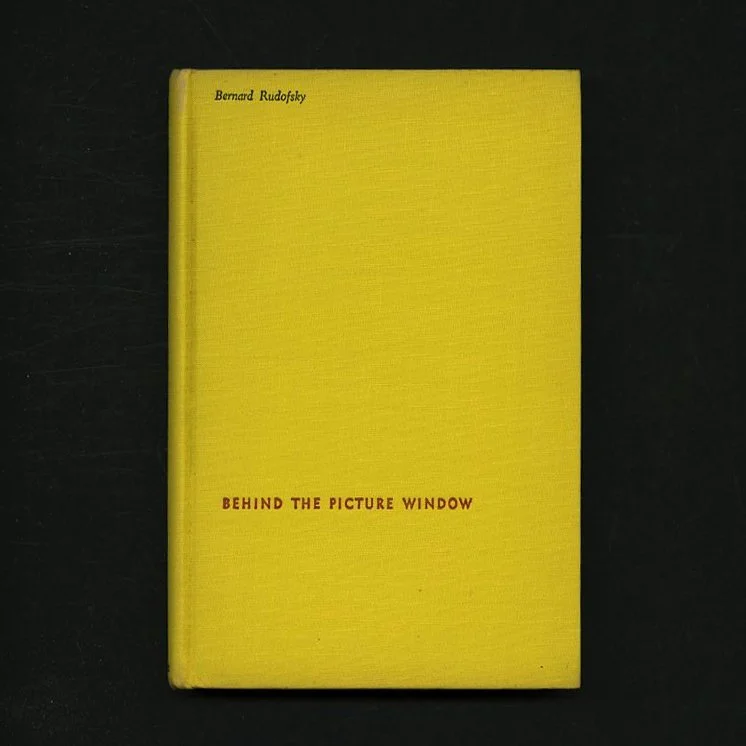 Image 2 of 6
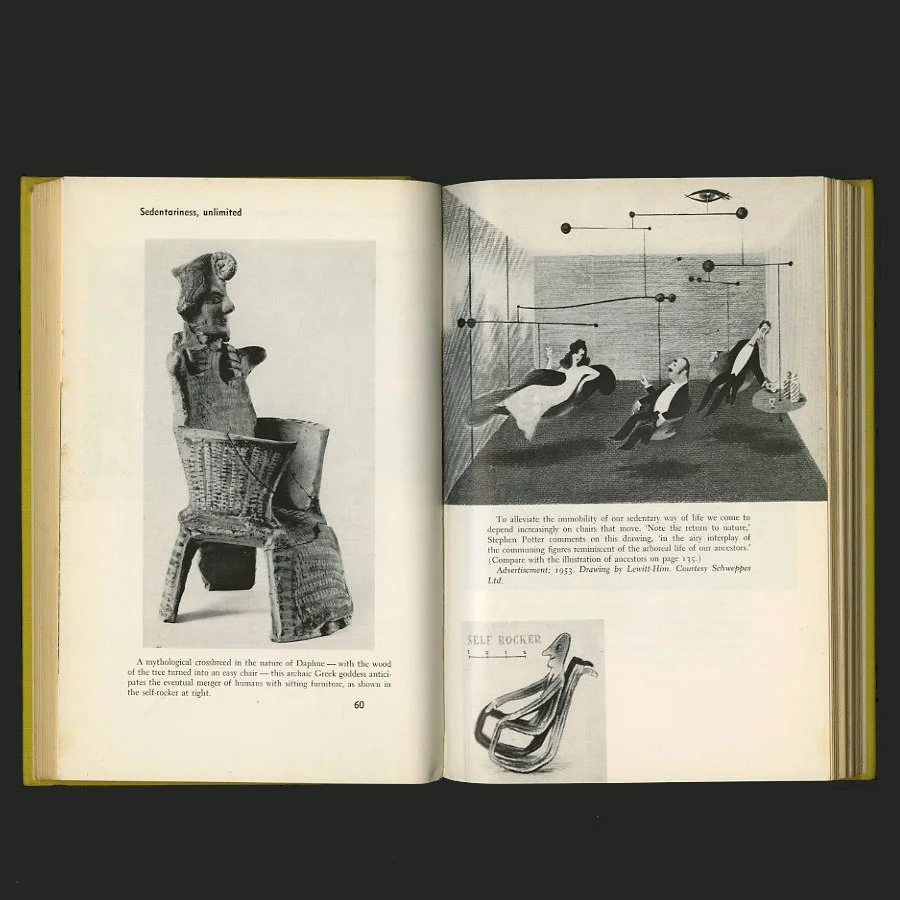 Image 3 of 6
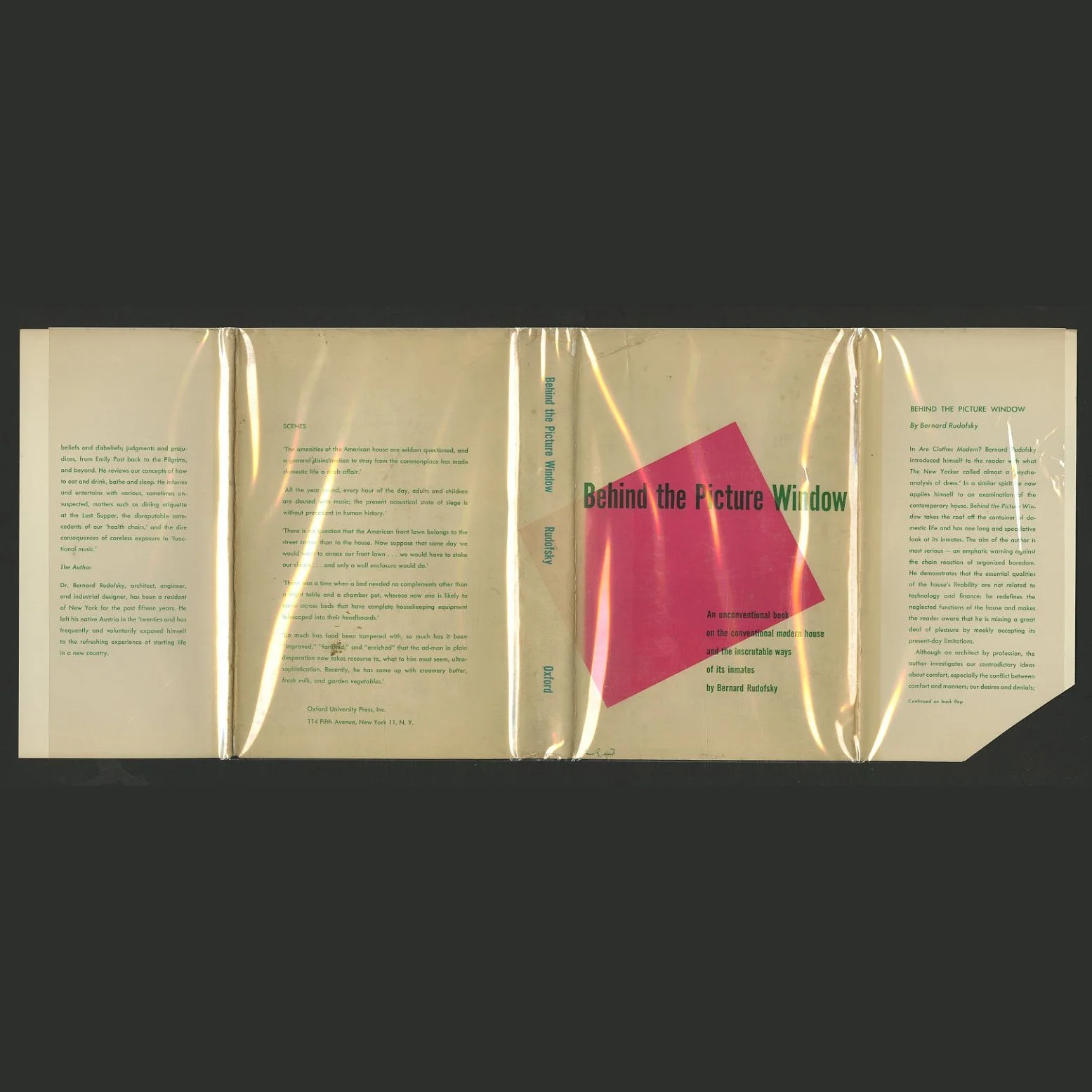 Image 4 of 6
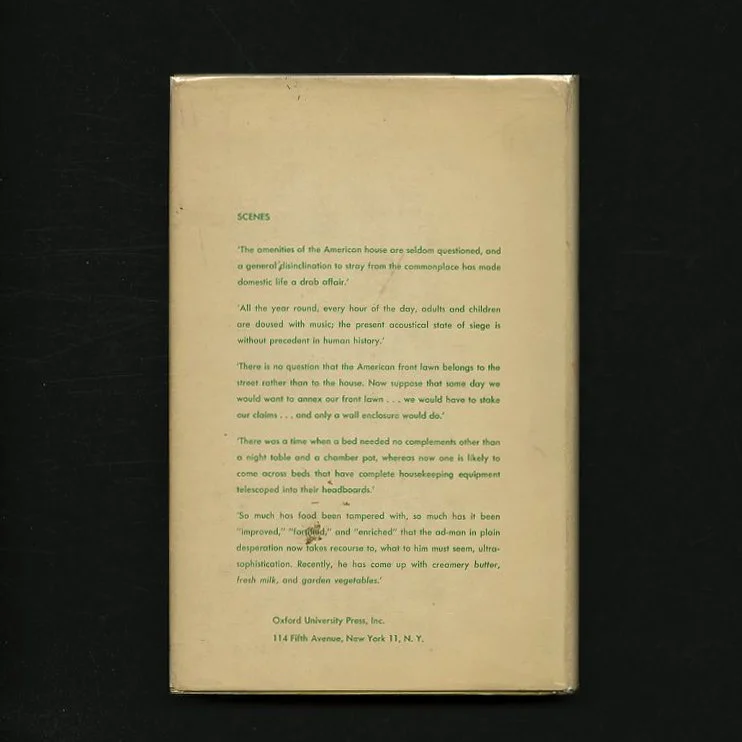 Image 5 of 6
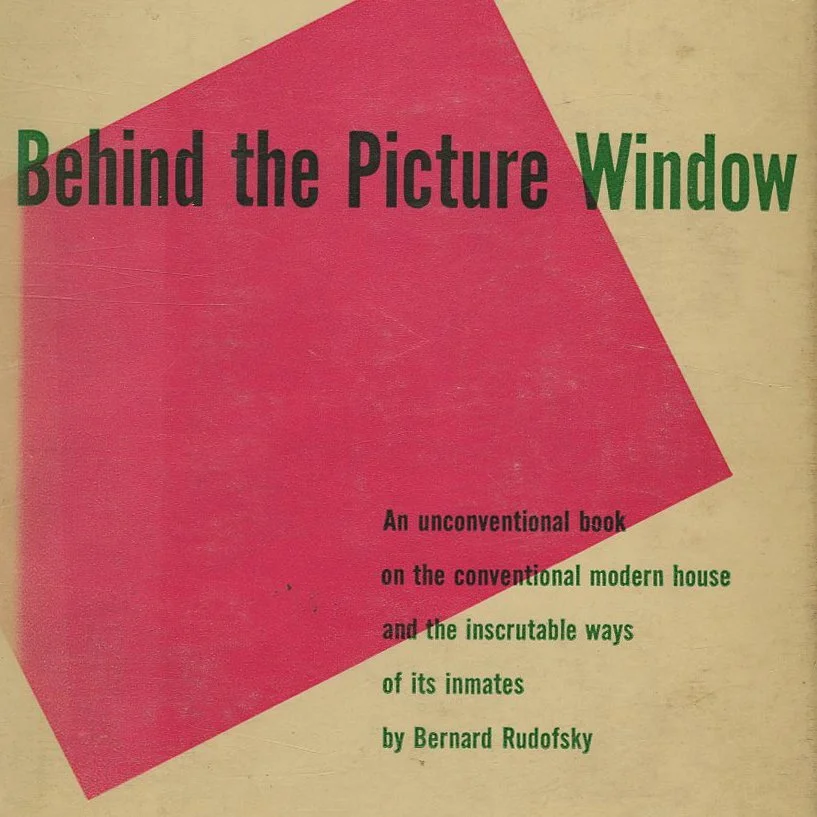 Image 6 of 6
Rudofsky, Bernard: BEHIND THE PICTURE WINDOW. New York: The Oxford University Press, 1955.
BEHIND THE PICTURE WINDOW
Bernard Rudofsky
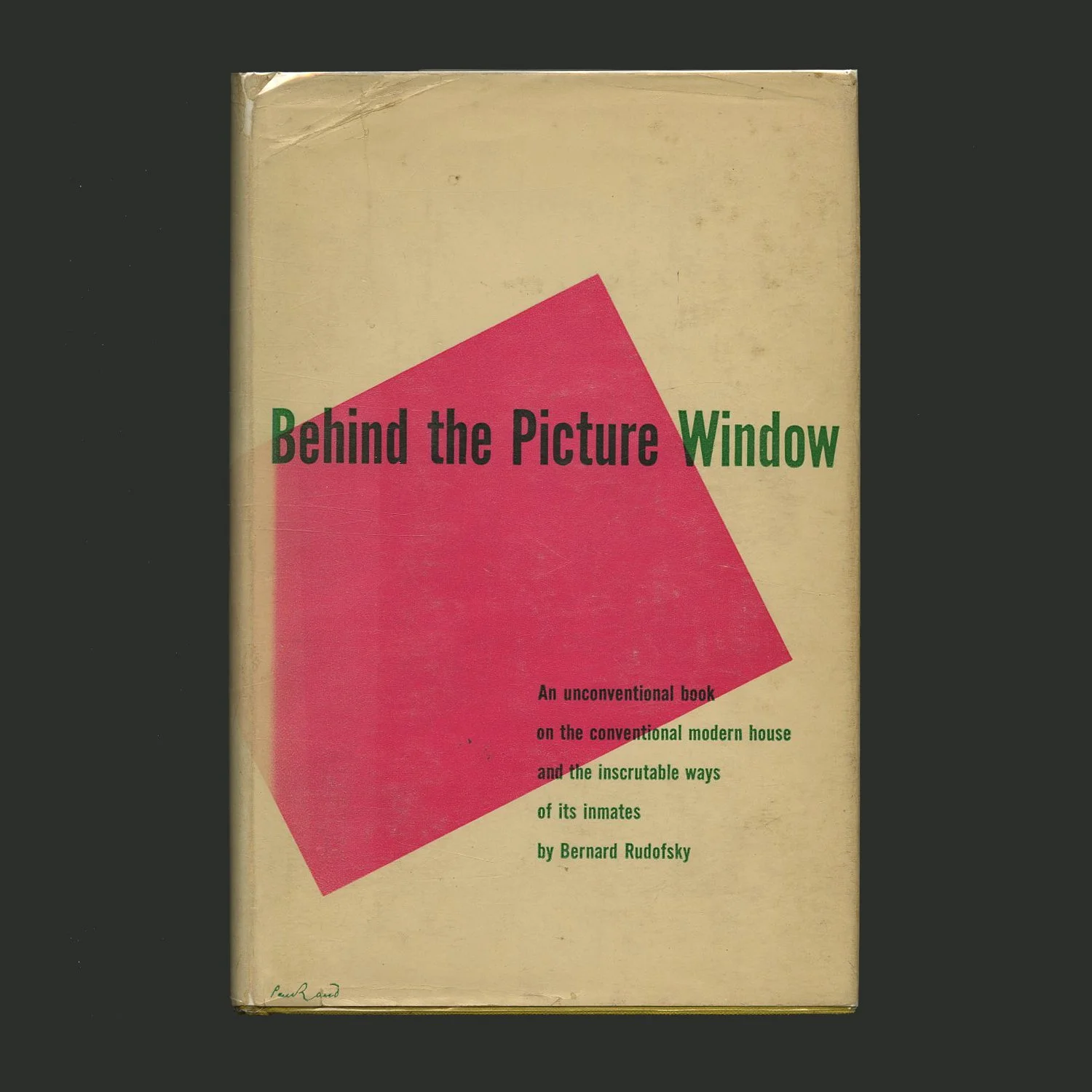
New York: The Oxford University Press, 1955. First edition. Octavo. Yellow cloth titled in red. Printed dust jacket. 201 pp. Lightly illustrated with halftones and line art. Dust jacket designed by Paul Rand. Price clipped jacket lightly soiled with a pushed spine crown resulting in a small closed tear. A fine copy in a very good or better dust jacket.
“The author’s title for this book is Uncle Sam’s Cabin. Due to circumstances beyond his control, it is now called Behind the Picture Window.”— Frontis
5.85 x 8.75-inch hardcover book with 201 pages illustrated with halftones and line art. Perhaps best viewed as a book length response to Russel and Mary Wright’s Guide to Easier Living, Mr. Rudofsky writes with great wit as he rebukes the aesthetic and sensuous poverty of our domestic environment, offering an antidote to anodyne shelter magazine pronouncements and to many of the prescriptions of high modernism--especially as regards clutter. As he puts it, “A house which does not burst its bounds with overcrowding does not seem to hold the promise of a decent life.”
The New York Times reviewed this book in 1955: “Clutter Can Be Beautiful; BEHIND THE PICTURE WINDOW. By Bernard Rudofsky. Illustrated. 201 pp. New York: Oxford University Press. $4.
“UNLIKE many authors, Bernard Rudofsky, architect, and industrial designer, is a modest man. He tells us that this collection of essays about humans and their houses fills no need. This is an error that must be corrected at once. If you have grown weary of the solemn pronouncements of the editors of our better magazines for home-owners, here is just the relief you require. Mr. Rudofsky is also a wise man. He sees no reason to take anyone seriously except himself. In case you have read one essay too many on party-giving, it will pay you to listen to Mr. Rudofsky. He will inform you that knives and forks are barbaric, and that the art of carving ought to have died out in the Dark Ages. “We should," he writes, "taboo carving at meals, if only to protect the less sanguine eaters from having to witness or perform dining-table surgery." Furthermore, he insists that we ought to lie down at dinner. After all, "modern chairs are just so many challenges to acrobatic talents." He admits, however, to a certain fondness for a dining-chair with a built-in weighing machine, and he points out the virtues of the vibrating chair, constructed on the principle of the milk-shake. There may be such a thing, the author argues, as too much music in the American home. One of his favorite candidates for oblivion is the late J. Leonard Corning, M. D., who sought to find "an inexpensive and anti-toxic remedy against thinking." Perhaps the doctor delivered his message too soon." Had he lived longer (he died in 1923) he would have been able, to see his therapeutics of the emotions put to use on a nation-wide scale. Radio was a beginning.” Mr. Rudofsky implies, “that no hi-fi cabinet can compare with a good stove."Art has always flourished in countries where good food was highly thought of," he reminds us. Besides, “the kitchen may provide a last refuge from our aching boredom.” He himself is bored with our bedrooms and bathrooms, not to mention our front lawns, which should be fenced off to provide the privacy we crave. NEEEDLESS to say, the author refuses to endorse the current campaign for uncluttered interiors. "A house which does not burst its bounds with overcrowding does not seem to hold the promise of a decent life," he believes. He adds that “dignity has suffered defeat after defeat, to the extent where our houses become laboratories for determining the breaking point of the human fiber. The fact cannot be ignored that we are making a fetish of minimum space." Though Mr. Rudofsky may not be invited to address the next annual convention of the American Institute of Decorators (they could scarcely forgive his yearning for cluttered rooms) he has probably made many more friends than enemies by writing this book. Among his warmest admirers will be counted many modern architects. They are not all so serious-minded as they have been advertised. Mr. Andrews, curator of manuscripts at the New York Historical Society, is the author of "Architecture, Ambition and Americans.”
Excerpted from a Museum of Moder Art press release: “An architect friend of Mr. Rudofsky, Felix Augenfeld, has written the following engaging sketch of him:
“Bernard Rudofsky is of the disapproving kind. His disapproval of the institutions of this world reaches a very unusual degree of intensity, a degree which makes his keen displeasure turn into creative impulse. And since he disapproves of many more things than the average person, he finds that, at the age of 39, he has "been successfully active in a number of varied fields. He is, or has been, an architect, engineer, industrial designer, stage designer, editor, musician, actor, fashion designer, shoemaker, archeologist, photographer and typographer. He considers human dwellings the crowning failure of mankind and has therefore made architecture his main profession.
“Like every Viennese he likes music and the stage. His other passion is traveling on which he has spent one-third of his time and every single penny he could spare. Thus he became acquainted with the Balkans and their primitive ways of living, with Asia Minor and Greece, where money is non-essential, with Switzerland, France, Scandinavia and the old Weimar Germany. He has come to the conclusion that people fight and quibble because of lack of privacy, dress stupidly, eat badly, and drink only to stop worrying.
“In 1931 he left Berlin and his architectural work to go South and find out how to enjoy life, to build and to work intelligently. For the next five years he indulged in his passion for living on remote Mediterranean islands like Procida, Ischia, Capri. A house he designed for himself was forbidden by the Military High Command since it was windowless and of such unusual design that it aroused suspicion.
“Mr. Rudofsky has frequently exposed himself voluntarily to the refreshing experience of starting life in a new country. He is in the habit of arriving there without any money in his pocket and of leaving for another country the very moment he is threatened with financial success. He had his narrowest escape in Milan, Italy, where in 1937 he was planning hotels radically different from today’s pattern and where he was editing and writing for a magazine of art and architecture.
“In 1938 he settled in Buenos Aires, but the winter climate drove him to tropical Rio de Janeiro. During three years of architectural work in Brazil he built some houses which in Europe were considered the -best on the American continent. Of his work Sacheverell Sitwell said, '...in the space of three years he built a pair of private houses that in their way are among the greatest successes of the whole modern movement. The Arnstein House...has been described as the most beautiful house in the entire American continent.
“He came to the United States three years ago when he won a prize in the Industrial Design Competition sponsored by the Museum of Modern Art. After learning his fifth language, he worked for a year as associate editor and art director of an architectural magazine.
“Most of Mr. Rudofsky’s time is spent on what seems to everyone most unrewarding and impractical--study and reading, collecting material in support of his favorite idea: that modern architecture is Just another kind of failure. He believes it is bound to be so because architecture is the most integrated expression of our way of living. In order to create good architecture ways of living must be critically investigated. Thus a revised scale o£ values has to be applied to the functions of our daily life, such as eating, drinking, sleeping, dressing, music making, recreation and social life. Architecture in the broader sense in which he conceives it has to be approached by readjusting the elements on which it is based.”
Bernard Rudofsky (Moravia, 1905 – 1988) was an American writer, architect, collector, teacher, designer, and social historian. Ada Louise Huxtable called him “the master iconoclast of the modern movement.”
Rudofsky earned a doctorate in architecture in Austria before working in Germany, Italy, and a dozen other countries. He temporarily settled in Brazil in the 1930s and opened an architectural practice there, building several notable residences in São Paulo. An entry in a 1941 design competition brought an invitation from MOMA to tour the US; in the wake of Pearl Harbor, as an Austrian native, he was given the option of staying in the US. He remained based in New York City until his death, although he continued to travel (sometimes for years at a stretch). Rudofsky variously taught at Yale, MIT, Cooper-Hewitt, Waseda University in Tokyo, and the Royal Academy of Fine Arts in Copenhagen. He was a Ford, Fulbright and Guggenheim Fellow.
Rudofsky was most influential for organizing a series of controversial MOMA exhibits in the 1940s, 1950s and 1960s. He is best remembered today for a number of urbane books that still provide relevant design insight that is concealed in entertaining, subversive sarcasm. His interests ranged from vernacular architecture to Japanese toilets and sandal design. Taken together, his written work constitutes a sustained argument for humane and sensible design.
In 1944 Rudofsky and his wife Berta were invited to Black Mountain College for two weeks. Bernard gave two lectures on the sad state of clothing design, calling contemporary dress "anachronistic, irrational, impractical and harmful" and literally unsuitable. One of his lectures was called "How Can People Expect to Have Good Architecture When They Wear Such Clothes?" Berta was convinced to organize an impromptu course on sandalmaking. Berta was invited back the following year, and their successful venture Bernardo Sandals was organized in 1947 and still thrives.
If the word legend has any meaning in the graphic arts and if the term legendary can be applied with accuracy to the career of any designer, it can certainly be applied to Paul Rand (1914-1996). By 1947, the legend was already firmly in place. By then Paul had completed his first career as a designer of media promotion at Esquire-Coronet --and as an outstanding cover designer for Apparel Arts and Directions. He was well along on a second career as an advertising designer at the William Weintraub agency which he had joined as art director at its founding. THOUGHTS ON DESIGN (with reproductions of almost one hundred of his designs and some of the best words yet written on graphic design) had just published -- an event that cemented his international reputation and identified him as a designer of influence from Zurich to Tokyo.
A chronology of Rand's design experience has paralleled the development of the modern design movement. Paul Rand’s first career in media promotion and cover design ran from 1937 to 1941, his second career in advertising design ran from 1941 to 1954, and his third career in corporate identification began in 1954. Paralleling these three careers there has been a consuming interest in design education and Paul Rand's fourth career as an educator started at Cooper Union in 1942. He taught at Pratt Institute in 1946 and in 1956 he accepted a post at Yale University's graduate school of design where he held the title of Professor of Graphic Design.
In 1937 Rand launched his first career at Esquire. Although he was only occasionally involved in the editorial layout of that magazine, he designed material on its behalf and turned out a spectacular series of covers for Apparel Arts, a quarterly published in conjunction with Esquire. In spite of a schedule that paid no heed to regular working hours or minimum wage scales, he managed in these crucial years to find time to design an impressive array of covers for other magazines, particularly Directions. From 1938 on his work was a regular feature of the exhibitions of the Art Directors Club.
Most contemporary designers are aware of Paul Rand's successful and compelling contributions to advertising design. What is not well known is the significant role he played in setting the pattern for future approaches to the advertising concept. Rand was probably the first of a long and distinguished line of art directors to work with and appreciate the unique talent of William Bernbach. Rand described his first meeting with Bernbach as "akin to Columbus discovering America," and went on to say, "This was my first encounter with a copywriter who understood visual ideas and who didn't come in with a yellow copy pad and a preconceived notion of what the layout should look like."
Rand spent fourteen years in advertising where he demonstrated the importance of the art director in advertising and helped break the isolation that once surrounded the art department. The final thought from THOUGHTS ON DESIGN is worth repeating: "Even if it is true that commonplace advertising and exhibitions of bad taste are indicative of the mental capacity of the man in the street, the opposing argument is equally valid. Bromidic advertising catering to that bad taste merely perpetuates that mediocrity and denies him one of the most easily accessible means of aesthetic development."
In 1954 when Paul Rand decided Madison Avenue was no longer a two-way street and he resigned from the Weintraub agency, he was cited as one of the ten best art directors by the Museum of Modern Art. The rest is design history.
László Moholy-Nagy, a pioneer typographer, photographer, and designer of the modern movement and a master at the Bauhaus in Weimar, may have come closest to defining the Rand style when he said Paul was "an idealist and a realist using the language of the poet and the businessman. He thinks in terms of need and function. He is able to analyze his problems, but his fantasy is boundless.”
BEHIND THE PICTURE WINDOW
Bernard Rudofsky
New York: The Oxford University Press, 1955. First edition. Octavo. Yellow cloth titled in red. Printed dust jacket. 201 pp. Lightly illustrated with halftones and line art. Dust jacket designed by Paul Rand. Price clipped jacket lightly soiled with a pushed spine crown resulting in a small closed tear. A fine copy in a very good or better dust jacket.
“The author’s title for this book is Uncle Sam’s Cabin. Due to circumstances beyond his control, it is now called Behind the Picture Window.”— Frontis
5.85 x 8.75-inch hardcover book with 201 pages illustrated with halftones and line art. Perhaps best viewed as a book length response to Russel and Mary Wright’s Guide to Easier Living, Mr. Rudofsky writes with great wit as he rebukes the aesthetic and sensuous poverty of our domestic environment, offering an antidote to anodyne shelter magazine pronouncements and to many of the prescriptions of high modernism--especially as regards clutter. As he puts it, “A house which does not burst its bounds with overcrowding does not seem to hold the promise of a decent life.”
The New York Times reviewed this book in 1955: “Clutter Can Be Beautiful; BEHIND THE PICTURE WINDOW. By Bernard Rudofsky. Illustrated. 201 pp. New York: Oxford University Press. $4.
“UNLIKE many authors, Bernard Rudofsky, architect, and industrial designer, is a modest man. He tells us that this collection of essays about humans and their houses fills no need. This is an error that must be corrected at once. If you have grown weary of the solemn pronouncements of the editors of our better magazines for home-owners, here is just the relief you require. Mr. Rudofsky is also a wise man. He sees no reason to take anyone seriously except himself. In case you have read one essay too many on party-giving, it will pay you to listen to Mr. Rudofsky. He will inform you that knives and forks are barbaric, and that the art of carving ought to have died out in the Dark Ages. “We should," he writes, "taboo carving at meals, if only to protect the less sanguine eaters from having to witness or perform dining-table surgery." Furthermore, he insists that we ought to lie down at dinner. After all, "modern chairs are just so many challenges to acrobatic talents." He admits, however, to a certain fondness for a dining-chair with a built-in weighing machine, and he points out the virtues of the vibrating chair, constructed on the principle of the milk-shake. There may be such a thing, the author argues, as too much music in the American home. One of his favorite candidates for oblivion is the late J. Leonard Corning, M. D., who sought to find "an inexpensive and anti-toxic remedy against thinking." Perhaps the doctor delivered his message too soon." Had he lived longer (he died in 1923) he would have been able, to see his therapeutics of the emotions put to use on a nation-wide scale. Radio was a beginning.” Mr. Rudofsky implies, “that no hi-fi cabinet can compare with a good stove."Art has always flourished in countries where good food was highly thought of," he reminds us. Besides, “the kitchen may provide a last refuge from our aching boredom.” He himself is bored with our bedrooms and bathrooms, not to mention our front lawns, which should be fenced off to provide the privacy we crave. NEEEDLESS to say, the author refuses to endorse the current campaign for uncluttered interiors. "A house which does not burst its bounds with overcrowding does not seem to hold the promise of a decent life," he believes. He adds that “dignity has suffered defeat after defeat, to the extent where our houses become laboratories for determining the breaking point of the human fiber. The fact cannot be ignored that we are making a fetish of minimum space." Though Mr. Rudofsky may not be invited to address the next annual convention of the American Institute of Decorators (they could scarcely forgive his yearning for cluttered rooms) he has probably made many more friends than enemies by writing this book. Among his warmest admirers will be counted many modern architects. They are not all so serious-minded as they have been advertised. Mr. Andrews, curator of manuscripts at the New York Historical Society, is the author of "Architecture, Ambition and Americans.”
Excerpted from a Museum of Moder Art press release: “An architect friend of Mr. Rudofsky, Felix Augenfeld, has written the following engaging sketch of him:
“Bernard Rudofsky is of the disapproving kind. His disapproval of the institutions of this world reaches a very unusual degree of intensity, a degree which makes his keen displeasure turn into creative impulse. And since he disapproves of many more things than the average person, he finds that, at the age of 39, he has "been successfully active in a number of varied fields. He is, or has been, an architect, engineer, industrial designer, stage designer, editor, musician, actor, fashion designer, shoemaker, archeologist, photographer and typographer. He considers human dwellings the crowning failure of mankind and has therefore made architecture his main profession.
“Like every Viennese he likes music and the stage. His other passion is traveling on which he has spent one-third of his time and every single penny he could spare. Thus he became acquainted with the Balkans and their primitive ways of living, with Asia Minor and Greece, where money is non-essential, with Switzerland, France, Scandinavia and the old Weimar Germany. He has come to the conclusion that people fight and quibble because of lack of privacy, dress stupidly, eat badly, and drink only to stop worrying.
“In 1931 he left Berlin and his architectural work to go South and find out how to enjoy life, to build and to work intelligently. For the next five years he indulged in his passion for living on remote Mediterranean islands like Procida, Ischia, Capri. A house he designed for himself was forbidden by the Military High Command since it was windowless and of such unusual design that it aroused suspicion.
“Mr. Rudofsky has frequently exposed himself voluntarily to the refreshing experience of starting life in a new country. He is in the habit of arriving there without any money in his pocket and of leaving for another country the very moment he is threatened with financial success. He had his narrowest escape in Milan, Italy, where in 1937 he was planning hotels radically different from today’s pattern and where he was editing and writing for a magazine of art and architecture.
“In 1938 he settled in Buenos Aires, but the winter climate drove him to tropical Rio de Janeiro. During three years of architectural work in Brazil he built some houses which in Europe were considered the -best on the American continent. Of his work Sacheverell Sitwell said, '...in the space of three years he built a pair of private houses that in their way are among the greatest successes of the whole modern movement. The Arnstein House...has been described as the most beautiful house in the entire American continent.
“He came to the United States three years ago when he won a prize in the Industrial Design Competition sponsored by the Museum of Modern Art. After learning his fifth language, he worked for a year as associate editor and art director of an architectural magazine.
“Most of Mr. Rudofsky’s time is spent on what seems to everyone most unrewarding and impractical--study and reading, collecting material in support of his favorite idea: that modern architecture is Just another kind of failure. He believes it is bound to be so because architecture is the most integrated expression of our way of living. In order to create good architecture ways of living must be critically investigated. Thus a revised scale o£ values has to be applied to the functions of our daily life, such as eating, drinking, sleeping, dressing, music making, recreation and social life. Architecture in the broader sense in which he conceives it has to be approached by readjusting the elements on which it is based.”
Bernard Rudofsky (Moravia, 1905 – 1988) was an American writer, architect, collector, teacher, designer, and social historian. Ada Louise Huxtable called him “the master iconoclast of the modern movement.”
Rudofsky earned a doctorate in architecture in Austria before working in Germany, Italy, and a dozen other countries. He temporarily settled in Brazil in the 1930s and opened an architectural practice there, building several notable residences in São Paulo. An entry in a 1941 design competition brought an invitation from MOMA to tour the US; in the wake of Pearl Harbor, as an Austrian native, he was given the option of staying in the US. He remained based in New York City until his death, although he continued to travel (sometimes for years at a stretch). Rudofsky variously taught at Yale, MIT, Cooper-Hewitt, Waseda University in Tokyo, and the Royal Academy of Fine Arts in Copenhagen. He was a Ford, Fulbright and Guggenheim Fellow.
Rudofsky was most influential for organizing a series of controversial MOMA exhibits in the 1940s, 1950s and 1960s. He is best remembered today for a number of urbane books that still provide relevant design insight that is concealed in entertaining, subversive sarcasm. His interests ranged from vernacular architecture to Japanese toilets and sandal design. Taken together, his written work constitutes a sustained argument for humane and sensible design.
In 1944 Rudofsky and his wife Berta were invited to Black Mountain College for two weeks. Bernard gave two lectures on the sad state of clothing design, calling contemporary dress "anachronistic, irrational, impractical and harmful" and literally unsuitable. One of his lectures was called "How Can People Expect to Have Good Architecture When They Wear Such Clothes?" Berta was convinced to organize an impromptu course on sandalmaking. Berta was invited back the following year, and their successful venture Bernardo Sandals was organized in 1947 and still thrives.
If the word legend has any meaning in the graphic arts and if the term legendary can be applied with accuracy to the career of any designer, it can certainly be applied to Paul Rand (1914-1996). By 1947, the legend was already firmly in place. By then Paul had completed his first career as a designer of media promotion at Esquire-Coronet --and as an outstanding cover designer for Apparel Arts and Directions. He was well along on a second career as an advertising designer at the William Weintraub agency which he had joined as art director at its founding. THOUGHTS ON DESIGN (with reproductions of almost one hundred of his designs and some of the best words yet written on graphic design) had just published -- an event that cemented his international reputation and identified him as a designer of influence from Zurich to Tokyo.
A chronology of Rand's design experience has paralleled the development of the modern design movement. Paul Rand’s first career in media promotion and cover design ran from 1937 to 1941, his second career in advertising design ran from 1941 to 1954, and his third career in corporate identification began in 1954. Paralleling these three careers there has been a consuming interest in design education and Paul Rand's fourth career as an educator started at Cooper Union in 1942. He taught at Pratt Institute in 1946 and in 1956 he accepted a post at Yale University's graduate school of design where he held the title of Professor of Graphic Design.
In 1937 Rand launched his first career at Esquire. Although he was only occasionally involved in the editorial layout of that magazine, he designed material on its behalf and turned out a spectacular series of covers for Apparel Arts, a quarterly published in conjunction with Esquire. In spite of a schedule that paid no heed to regular working hours or minimum wage scales, he managed in these crucial years to find time to design an impressive array of covers for other magazines, particularly Directions. From 1938 on his work was a regular feature of the exhibitions of the Art Directors Club.
Most contemporary designers are aware of Paul Rand's successful and compelling contributions to advertising design. What is not well known is the significant role he played in setting the pattern for future approaches to the advertising concept. Rand was probably the first of a long and distinguished line of art directors to work with and appreciate the unique talent of William Bernbach. Rand described his first meeting with Bernbach as "akin to Columbus discovering America," and went on to say, "This was my first encounter with a copywriter who understood visual ideas and who didn't come in with a yellow copy pad and a preconceived notion of what the layout should look like."
Rand spent fourteen years in advertising where he demonstrated the importance of the art director in advertising and helped break the isolation that once surrounded the art department. The final thought from THOUGHTS ON DESIGN is worth repeating: "Even if it is true that commonplace advertising and exhibitions of bad taste are indicative of the mental capacity of the man in the street, the opposing argument is equally valid. Bromidic advertising catering to that bad taste merely perpetuates that mediocrity and denies him one of the most easily accessible means of aesthetic development."
In 1954 when Paul Rand decided Madison Avenue was no longer a two-way street and he resigned from the Weintraub agency, he was cited as one of the ten best art directors by the Museum of Modern Art. The rest is design history.
László Moholy-Nagy, a pioneer typographer, photographer, and designer of the modern movement and a master at the Bauhaus in Weimar, may have come closest to defining the Rand style when he said Paul was "an idealist and a realist using the language of the poet and the businessman. He thinks in terms of need and function. He is able to analyze his problems, but his fantasy is boundless.”