
 Image 1 of 3
 Image 2 of 3
 Image 3 of 3
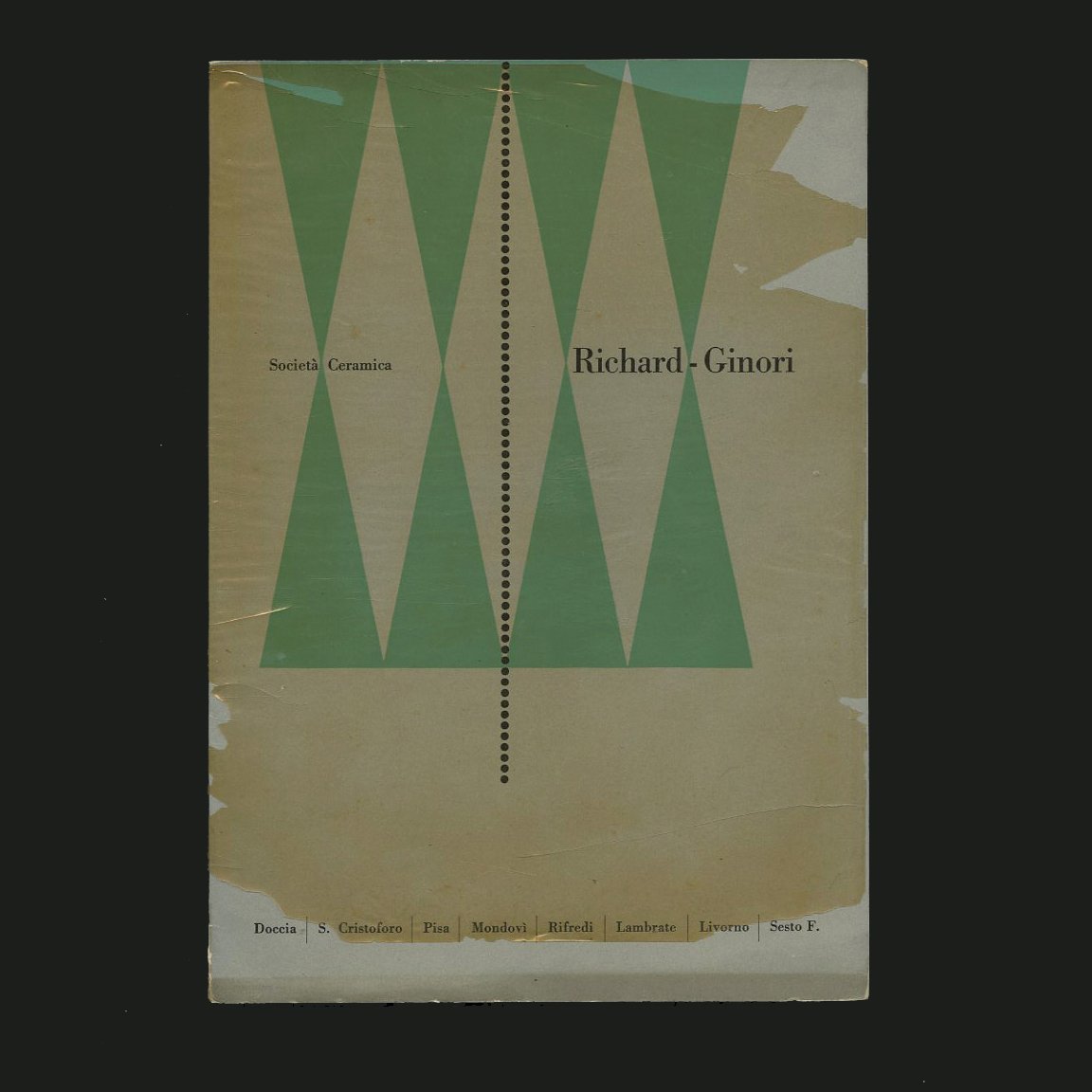
GINORI, RICHARD. Gio Ponti (Presentazione): SOCIETA' CERAMICA. RICHARD - GINORI. Milano: Tip. A. Lucini & C., [c. 1955].
SOCIETA' CERAMICA. RICHARD - GINORI
Gio Ponti [Presentazione]
Studio Boggeri [DESIGN]
Milano: Tip. A. Lucini & C., [c. 1955]. First edition. Text in Italian. Octavo. Letterpress thick wrappers. Publishers Glassine wrappers. 78 pp. Fully illustrated with black and white reproductions. Sensitive page design and typography courtesy of Studio Boggeri. Glassine chipped with front flap separated and laid in. Uniform quarter-inch discolored band to both wrappers, otherwise a fine copy. Very sharp indeed.
7.5 x 10.375-inch softcover book with 78 pages fully illustrated with black and white halftones of Ginori products, as well as production photography. The monograph describes the resumption of activities after the war, during which the factories in S. Cristoforo, Lambrate, Pisa, and Doccia were heavily damaged. It then describes the activities in the factories of Doccia, San Cristoforo (sanitary ware), Pisa and Mondovì (decorated ceramics), Lambrate, Leghorn (electrical insulators), and Sesto Fiorentino.
Gio Ponti began working with Richard-Ginori in 1922 and became artistic director in 1923 – a post he would hold for a decade, until 1933. Ponti understood the challenge in the ability to break boundaries and connect art and design, crafts and industry, manual quality and industrial processing.
Ponti revolutionized the production of Richard Ginori with ceramic pieces, as he describes “of vaguely neoclassical inspiration, with Etruscan suggestions, turned toward the modern with ironic elegance.” Finely executed, Ponti’s works for Richard Ginori were widely admired at the 1923 Biennale in Monza so much so that he was named artistic director for the company that same year. At the Exposition Internationale des Arts Décoratifs et Industriels Modernes in Paris just two years later, Richard Ginori was awarded two grand prizes, one for Ponti and his ceramic designs.
Ponti renewed artistic expression with a modern take on classical ornamentation and decoration, forms that had once been forgotten were newly found, architecture and lively figures graced his objects. Further, his works illustrated a collaboration of art and industry as his designs were increasing applied to functional forms and not just decorative objects. Under Ponti’s direction, Richard Ginori became widely acclaimed in Italy, recognized for their precision in design, study in detail and perfect execution. During his tenure at the firm and in the years following, Ponti would create more than 400 designs.
Antonio Boggeri’s [Italian, 1900– 1989] first love was the violin. The musical prodigy enrolled at the Technical Institute of Pavia at age 16 where he added a Kodak 4x4 camera to his creative toolbox. Within two years he relocated to Milan and met Antonio Crespi. In 1924, Crespi bought the leading printing company in Milan, Alfieri & Lacroix and Boggeri was offered a job at Alferi & Lacroix.
After Boggeri gained printing experience at Alferi & Lacroix, he opened Studio Boggeri in Milan in 1933. Boggeri was heavily influenced by Russian photomontage techniques, the typographic modernity of Jan Tschichold and the work emanating from the Dessau Bauhaus. Before Fascism calcified European culture Milan was one of the Continental creative crossroads, attracting talent from neighboring Switzerland, Austria, and all the southern regions of Italy.
Studio Boggeri quickly grew into one of the best and most important design studios in the world. The Studio connected the dots between Italian and Swiss graphic design like no one before, solidifying Modernism as the dominant principle of graphic design. No other firm could match the an outstanding Boggeri roster : Albe Steiner, Aldo Calabresi, Antonio Boggeri himself, Armando Milani, Bob Noorda, Bruno Monguzzi, Bruno Munari, Carlo Vivarelli, Enzo Mari, Ezio Bonini, Fortunato Depero, Franco Grignani, Imre Reiner, Marcello Nizzoli, Max Huber, Remo Muratore, René Martinelli, Roberto Sambonet, Walter Ballmer, Xanti Schawinsky, and many others.
Antonio Boggeri was invited by Alliance Graphique Internationale for exhibition in Paris (1951), London (1956), Lausanne (1957) and Milan (1961). He received the Triennale gold medal and was awarded the Life of Adverstising Award in 1967. He appointed an honorary member of Art Director Club of Milan. Studio Boggeri closed in 1981. Antonio Boggeri passed away in Santa Margherita Ligure on November 10th, 1989.
Gio Ponti [Italian, 1891–1979] excelled at painting as a child and expressed a fervent interest in the arts. Feeling that a career in architecture was preferable to that of a painter, Ponti’s parents encouraged him to pursue the former and in 1914 he enrolled at the Faculty of Architecture at the Politecnico di Milano. His studies were interrupted by war, and in 1915 he was forced to postpone his education. He served as a captain in the Pontonier Corps until 1919, earning multiple military honors.
After graduating in 1921, Ponti married Giulia Vimercati, the daughter of local aristocracy and started an architecture firm. During this time, Ponti aligned himself with the neoclassical movement, Novecento and championed a revival of the arts and culture.
In 1928, Ponti founded Domus, a periodical tailored to artists and designers, as well as the broader public. A shift occurred in the 1930s when Ponti took up a teaching post at his alma mater, the Politecnico di Milano. In search of new methods to express Italian modernity, Ponti distanced himself from the sentiments of Novecento and sought to reconcile art and industry. Together with the engineers, Eugenio Soncini and Antonio Fornaroli, Ponti enjoyed great success in the industrial sector, securing various commissions throughout Italy. In the 1950s, he gained international fame with the design of the Pirelli Tower in Milan and he was asked to be a part of the urban renewal of Baghdad, collaborating with top architects from around the world. His 1957 book, Amate l’architettura, is considered to be a microcosm of his work —an incredible legacy spanning art, architecture, industrial design, publishing and academia.
SOCIETA' CERAMICA. RICHARD - GINORI
Gio Ponti [Presentazione]
Studio Boggeri [DESIGN]
Milano: Tip. A. Lucini & C., [c. 1955]. First edition. Text in Italian. Octavo. Letterpress thick wrappers. Publishers Glassine wrappers. 78 pp. Fully illustrated with black and white reproductions. Sensitive page design and typography courtesy of Studio Boggeri. Glassine chipped with front flap separated and laid in. Uniform quarter-inch discolored band to both wrappers, otherwise a fine copy. Very sharp indeed.
7.5 x 10.375-inch softcover book with 78 pages fully illustrated with black and white halftones of Ginori products, as well as production photography. The monograph describes the resumption of activities after the war, during which the factories in S. Cristoforo, Lambrate, Pisa, and Doccia were heavily damaged. It then describes the activities in the factories of Doccia, San Cristoforo (sanitary ware), Pisa and Mondovì (decorated ceramics), Lambrate, Leghorn (electrical insulators), and Sesto Fiorentino.
Gio Ponti began working with Richard-Ginori in 1922 and became artistic director in 1923 – a post he would hold for a decade, until 1933. Ponti understood the challenge in the ability to break boundaries and connect art and design, crafts and industry, manual quality and industrial processing.
Ponti revolutionized the production of Richard Ginori with ceramic pieces, as he describes “of vaguely neoclassical inspiration, with Etruscan suggestions, turned toward the modern with ironic elegance.” Finely executed, Ponti’s works for Richard Ginori were widely admired at the 1923 Biennale in Monza so much so that he was named artistic director for the company that same year. At the Exposition Internationale des Arts Décoratifs et Industriels Modernes in Paris just two years later, Richard Ginori was awarded two grand prizes, one for Ponti and his ceramic designs.
Ponti renewed artistic expression with a modern take on classical ornamentation and decoration, forms that had once been forgotten were newly found, architecture and lively figures graced his objects. Further, his works illustrated a collaboration of art and industry as his designs were increasing applied to functional forms and not just decorative objects. Under Ponti’s direction, Richard Ginori became widely acclaimed in Italy, recognized for their precision in design, study in detail and perfect execution. During his tenure at the firm and in the years following, Ponti would create more than 400 designs.
Antonio Boggeri’s [Italian, 1900– 1989] first love was the violin. The musical prodigy enrolled at the Technical Institute of Pavia at age 16 where he added a Kodak 4x4 camera to his creative toolbox. Within two years he relocated to Milan and met Antonio Crespi. In 1924, Crespi bought the leading printing company in Milan, Alfieri & Lacroix and Boggeri was offered a job at Alferi & Lacroix.
After Boggeri gained printing experience at Alferi & Lacroix, he opened Studio Boggeri in Milan in 1933. Boggeri was heavily influenced by Russian photomontage techniques, the typographic modernity of Jan Tschichold and the work emanating from the Dessau Bauhaus. Before Fascism calcified European culture Milan was one of the Continental creative crossroads, attracting talent from neighboring Switzerland, Austria, and all the southern regions of Italy.
Studio Boggeri quickly grew into one of the best and most important design studios in the world. The Studio connected the dots between Italian and Swiss graphic design like no one before, solidifying Modernism as the dominant principle of graphic design. No other firm could match the an outstanding Boggeri roster : Albe Steiner, Aldo Calabresi, Antonio Boggeri himself, Armando Milani, Bob Noorda, Bruno Monguzzi, Bruno Munari, Carlo Vivarelli, Enzo Mari, Ezio Bonini, Fortunato Depero, Franco Grignani, Imre Reiner, Marcello Nizzoli, Max Huber, Remo Muratore, René Martinelli, Roberto Sambonet, Walter Ballmer, Xanti Schawinsky, and many others.
Antonio Boggeri was invited by Alliance Graphique Internationale for exhibition in Paris (1951), London (1956), Lausanne (1957) and Milan (1961). He received the Triennale gold medal and was awarded the Life of Adverstising Award in 1967. He appointed an honorary member of Art Director Club of Milan. Studio Boggeri closed in 1981. Antonio Boggeri passed away in Santa Margherita Ligure on November 10th, 1989.
Gio Ponti [Italian, 1891–1979] excelled at painting as a child and expressed a fervent interest in the arts. Feeling that a career in architecture was preferable to that of a painter, Ponti’s parents encouraged him to pursue the former and in 1914 he enrolled at the Faculty of Architecture at the Politecnico di Milano. His studies were interrupted by war, and in 1915 he was forced to postpone his education. He served as a captain in the Pontonier Corps until 1919, earning multiple military honors.
After graduating in 1921, Ponti married Giulia Vimercati, the daughter of local aristocracy and started an architecture firm. During this time, Ponti aligned himself with the neoclassical movement, Novecento and championed a revival of the arts and culture.
In 1928, Ponti founded Domus, a periodical tailored to artists and designers, as well as the broader public. A shift occurred in the 1930s when Ponti took up a teaching post at his alma mater, the Politecnico di Milano. In search of new methods to express Italian modernity, Ponti distanced himself from the sentiments of Novecento and sought to reconcile art and industry. Together with the engineers, Eugenio Soncini and Antonio Fornaroli, Ponti enjoyed great success in the industrial sector, securing various commissions throughout Italy. In the 1950s, he gained international fame with the design of the Pirelli Tower in Milan and he was asked to be a part of the urban renewal of Baghdad, collaborating with top architects from around the world. His 1957 book, Amate l’architettura, is considered to be a microcosm of his work —an incredible legacy spanning art, architecture, industrial design, publishing and academia.