
 Image 1 of 13
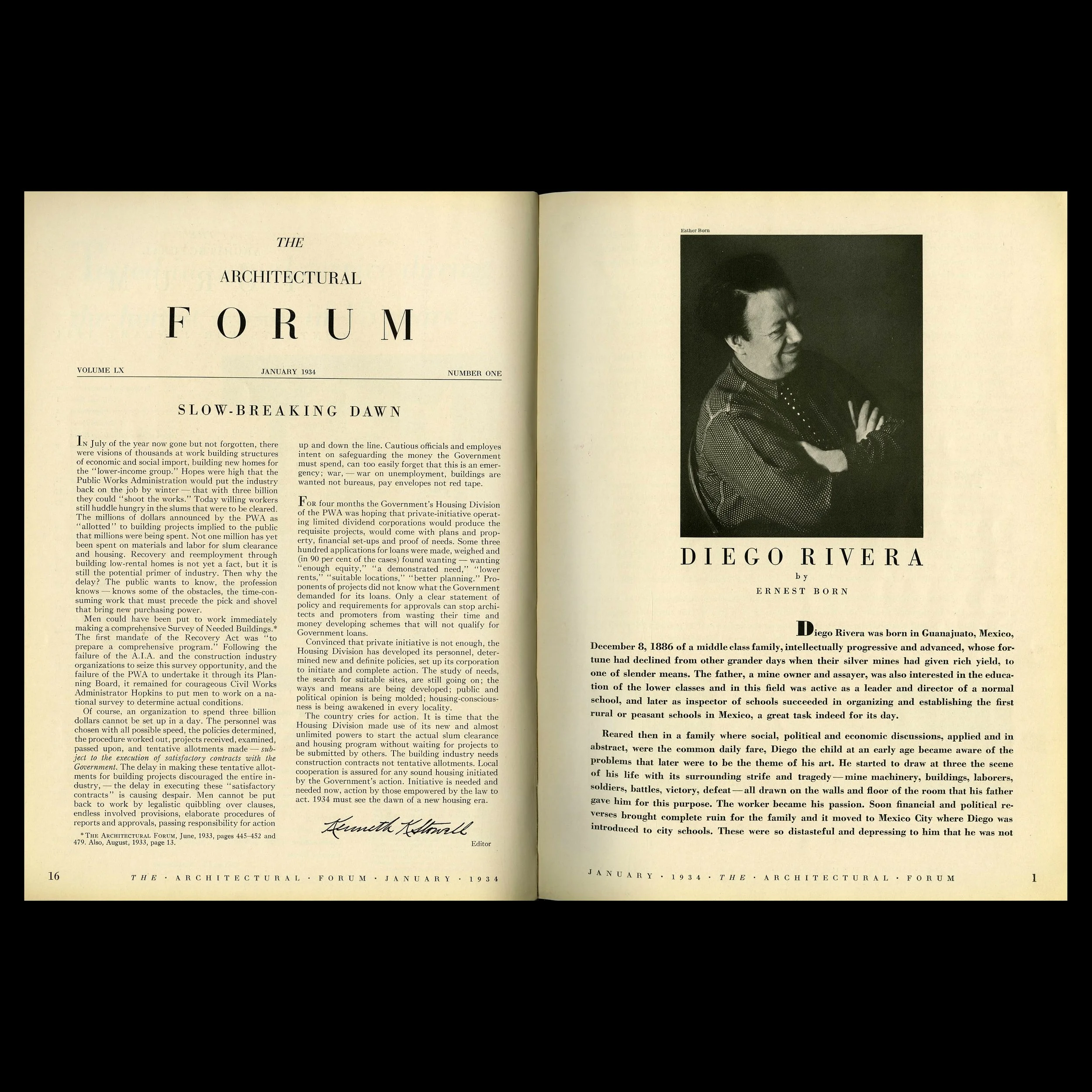 Image 2 of 13
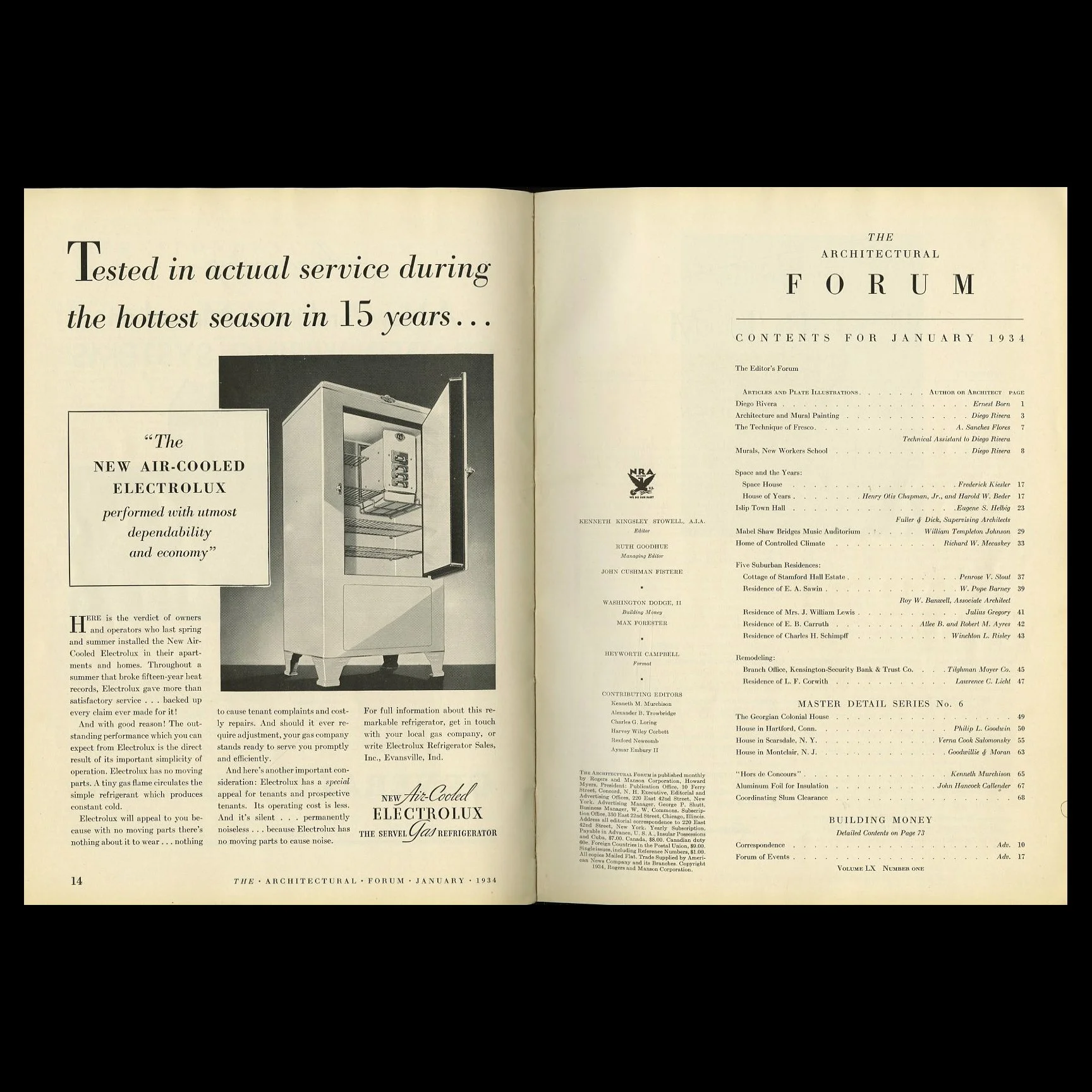 Image 3 of 13
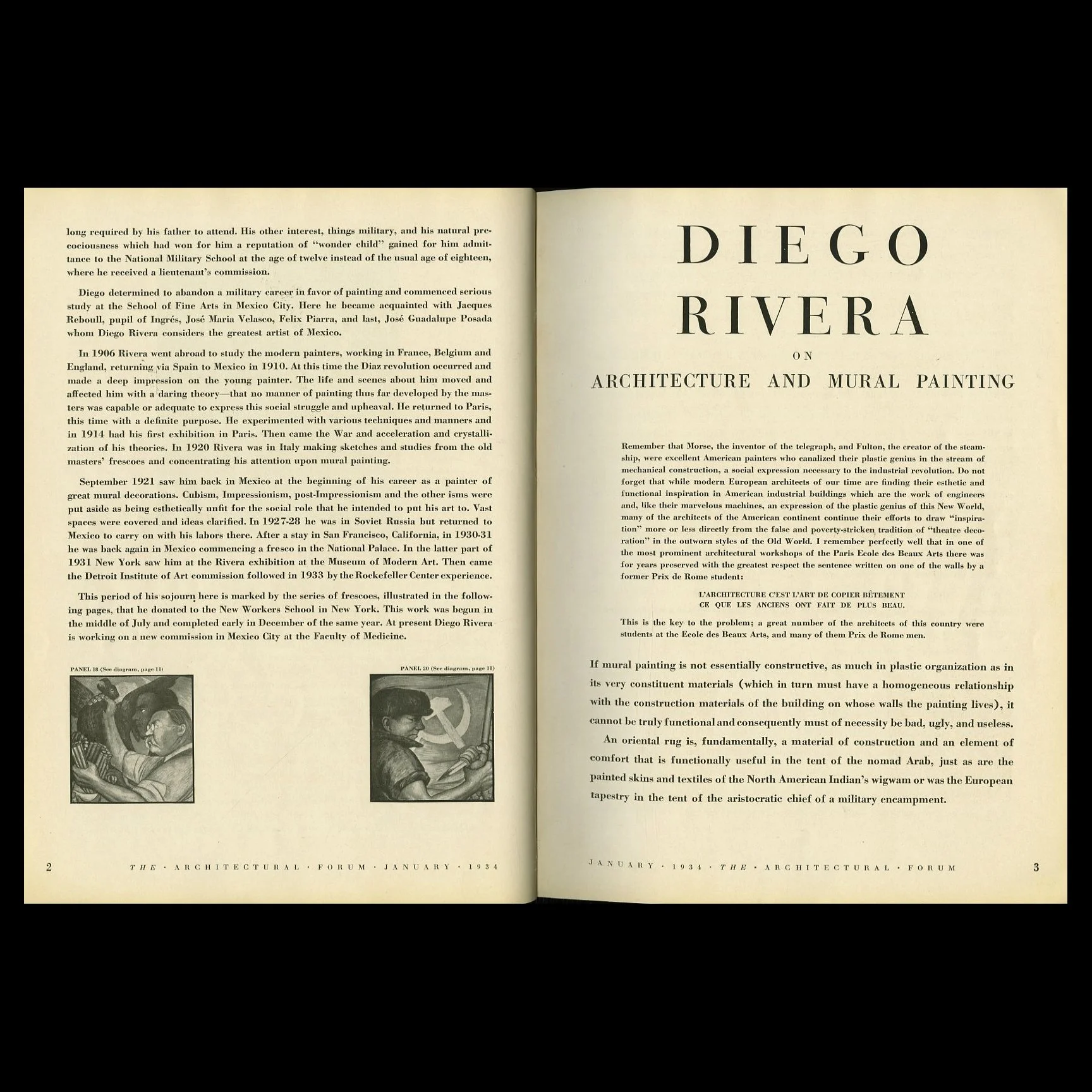 Image 4 of 13
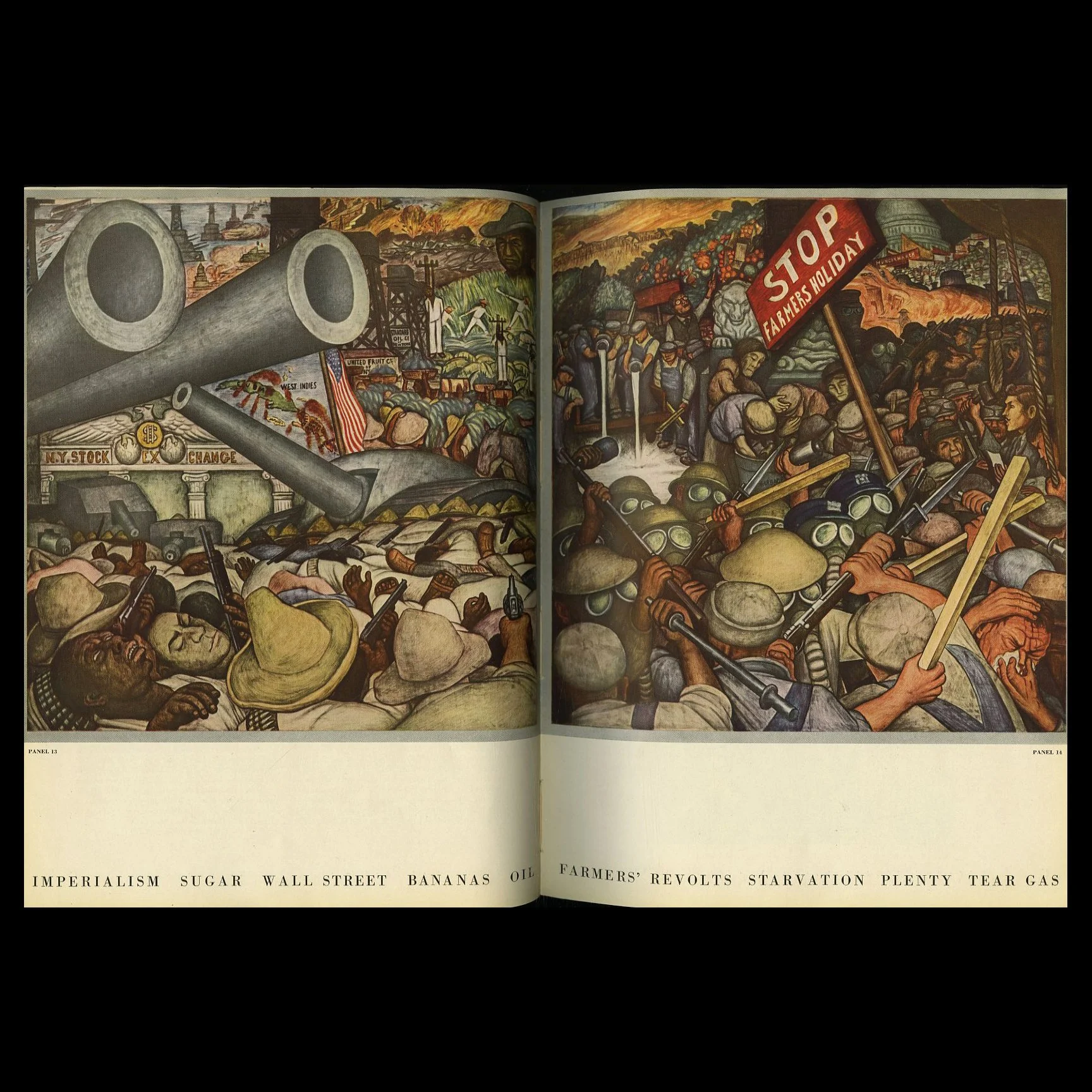 Image 5 of 13
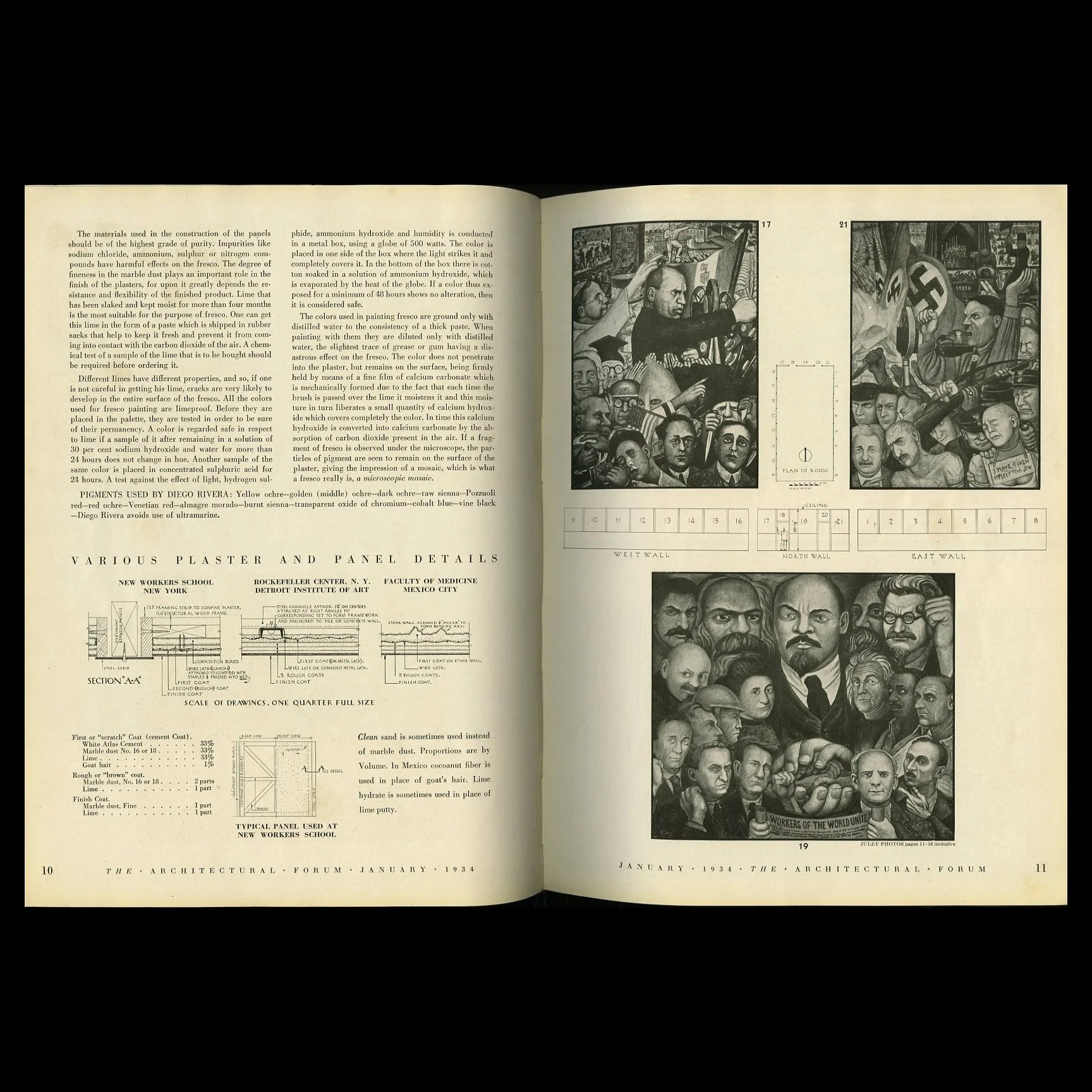 Image 6 of 13
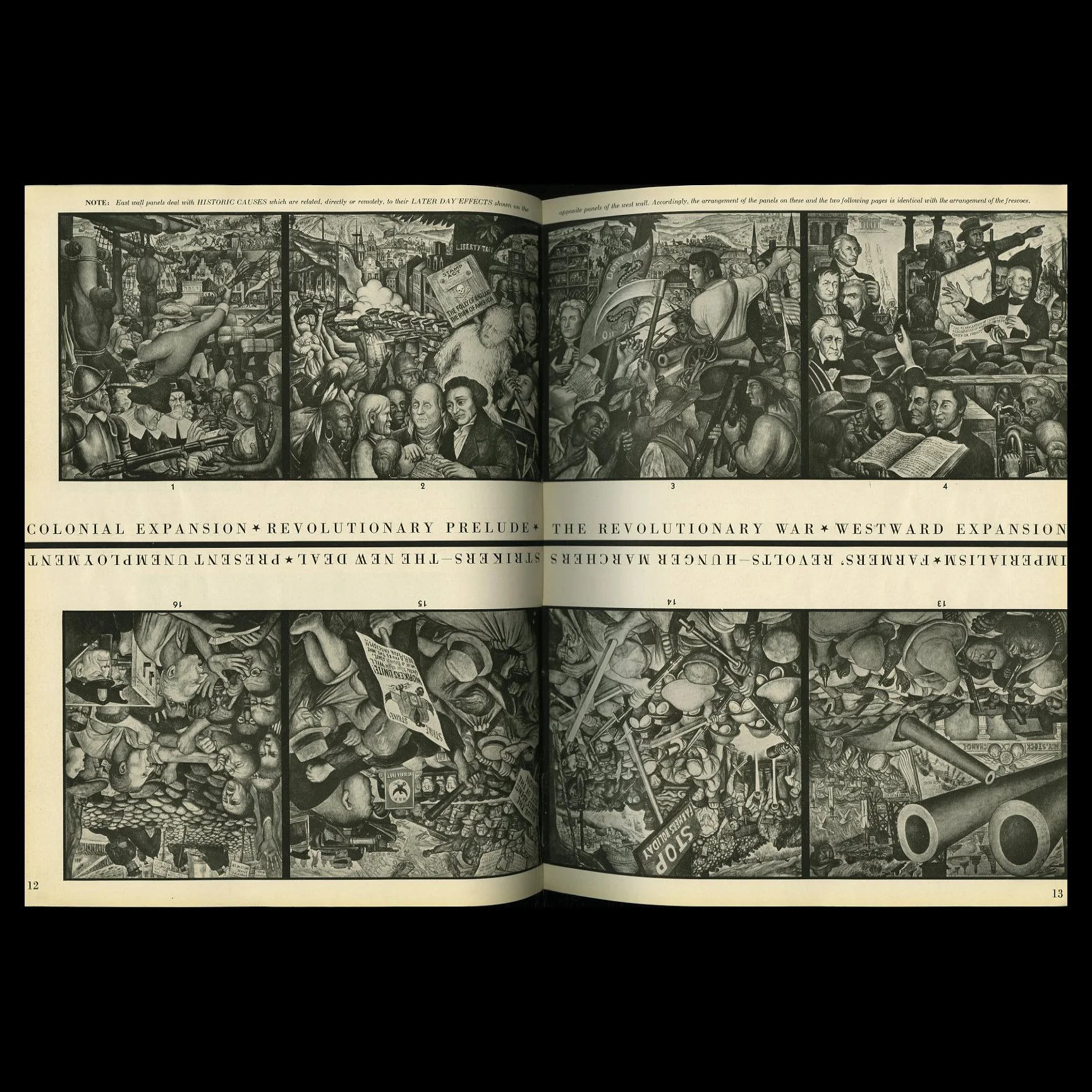 Image 7 of 13
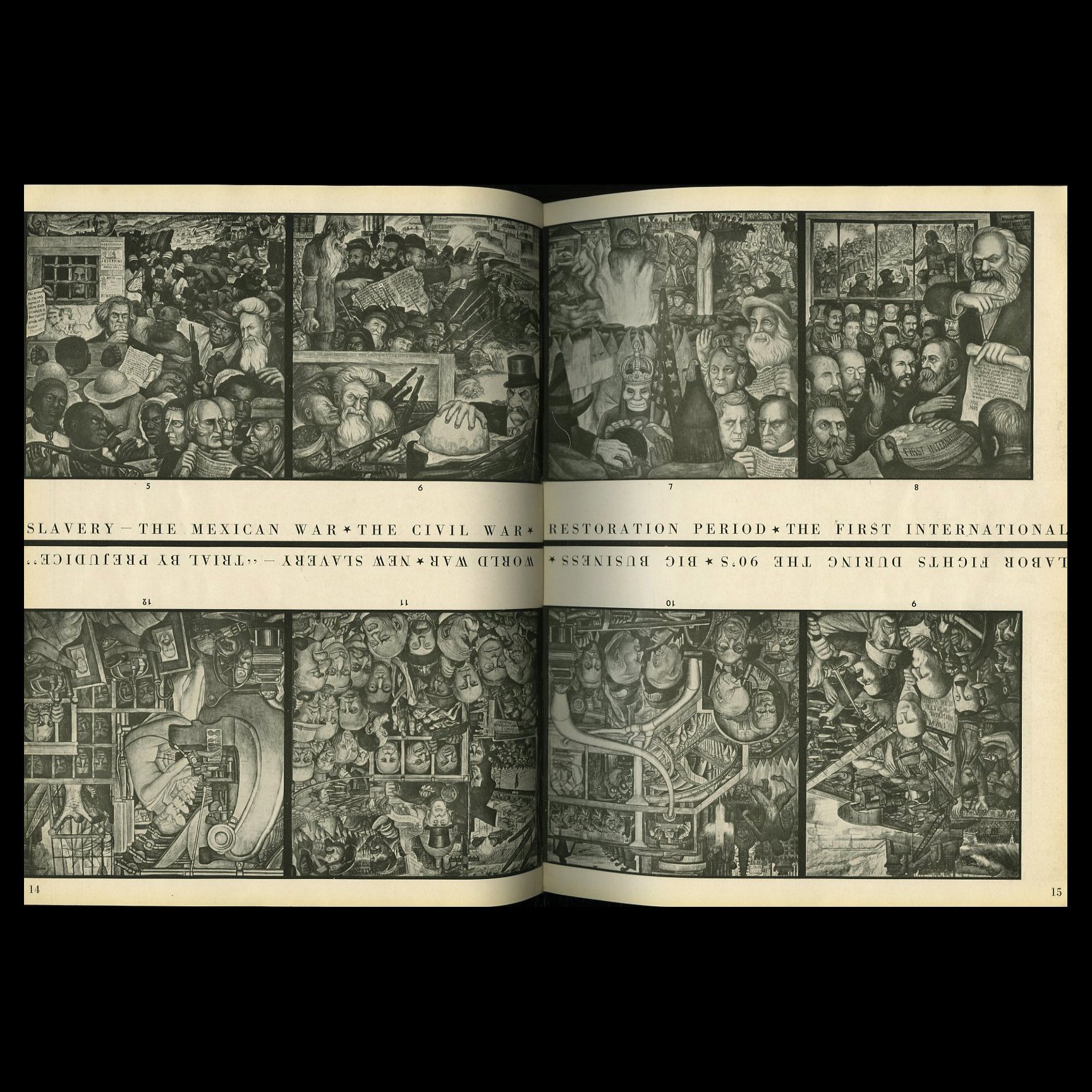 Image 8 of 13
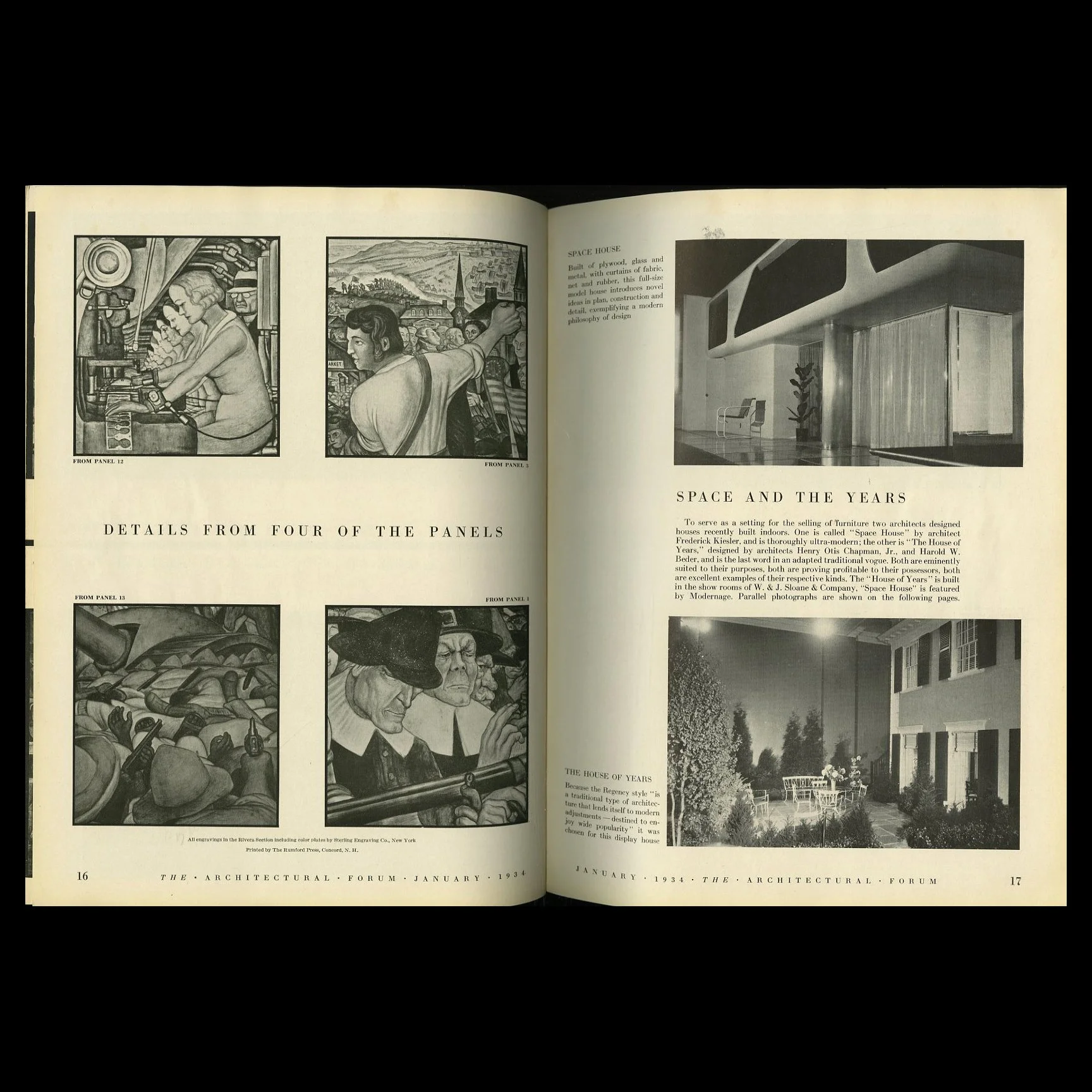 Image 9 of 13
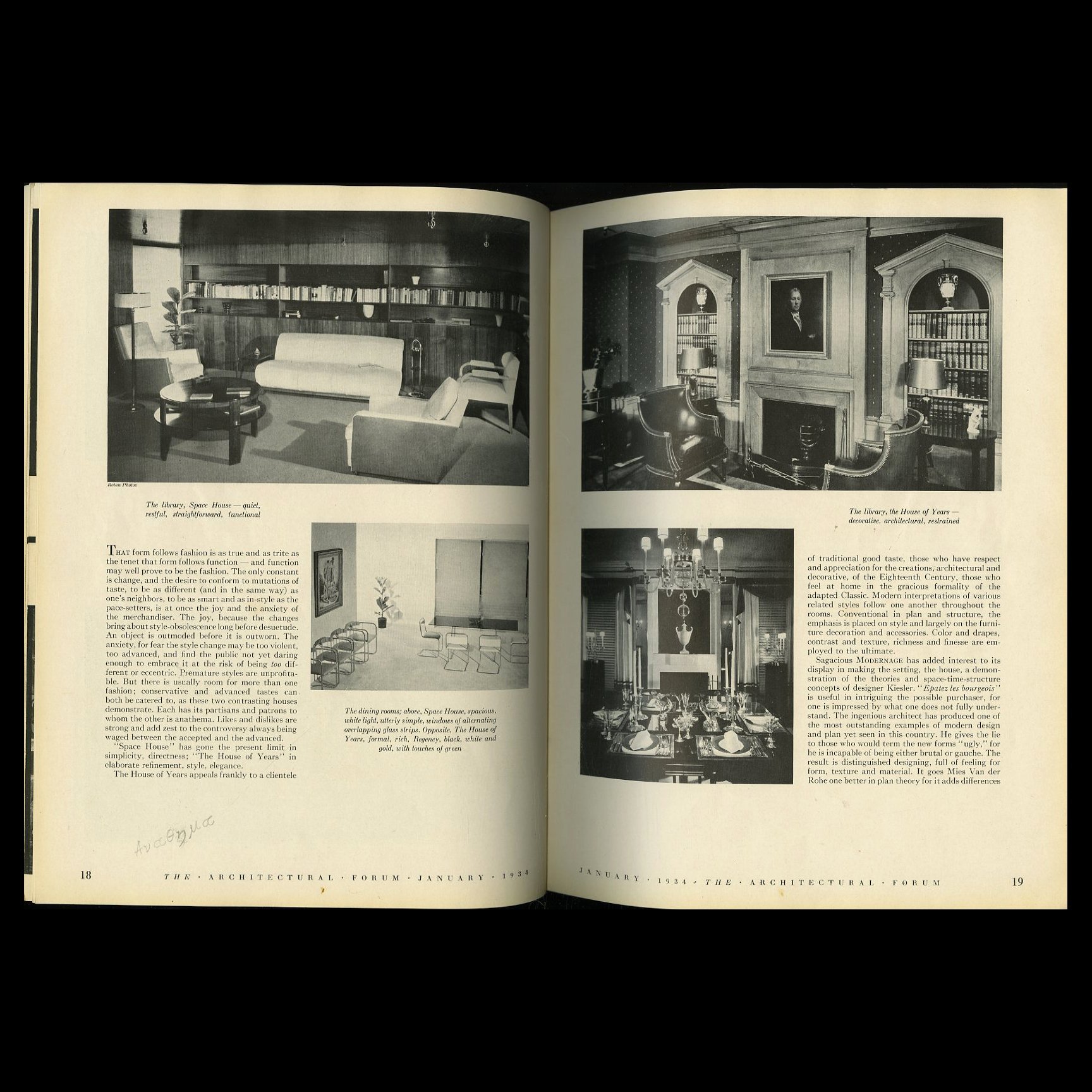 Image 10 of 13
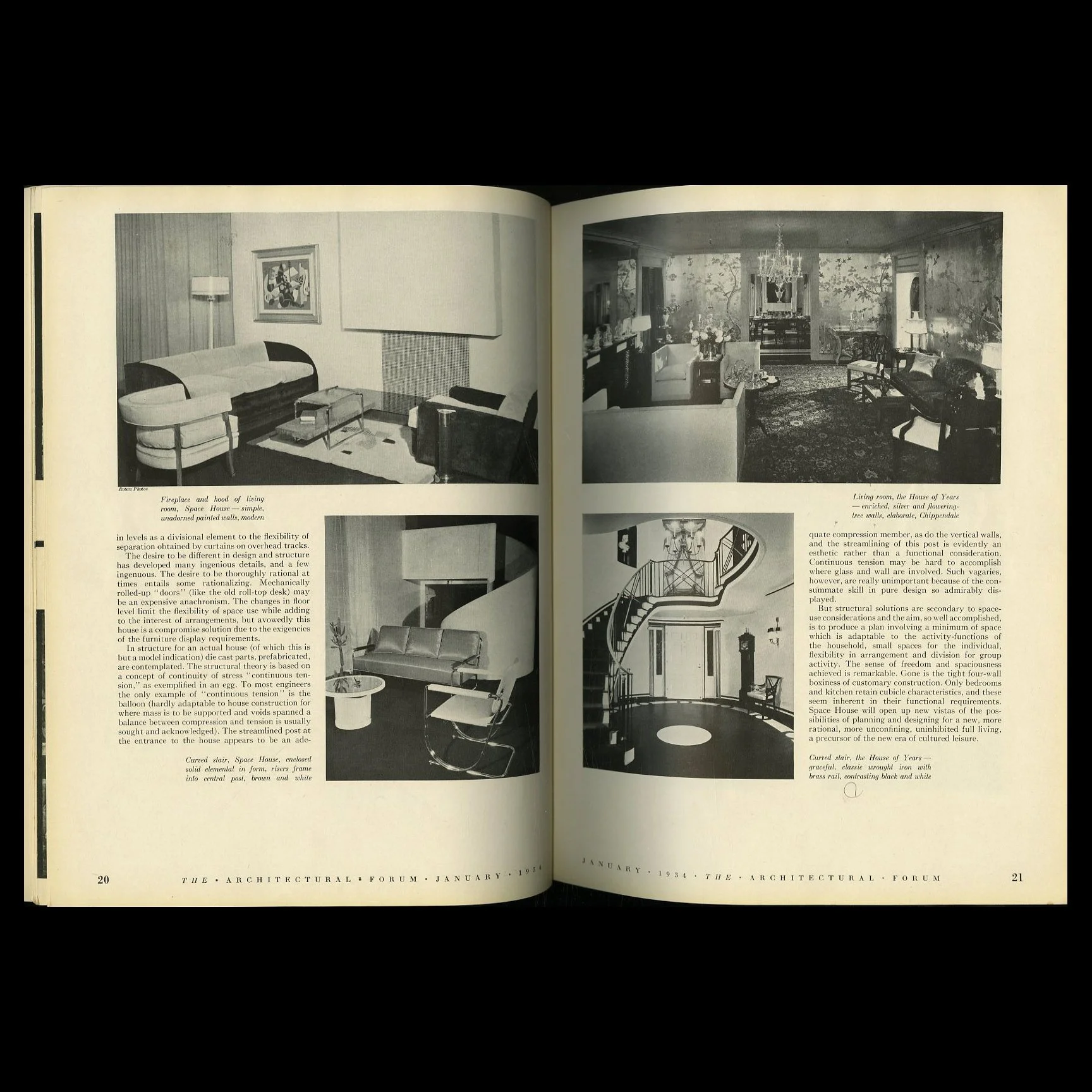 Image 11 of 13
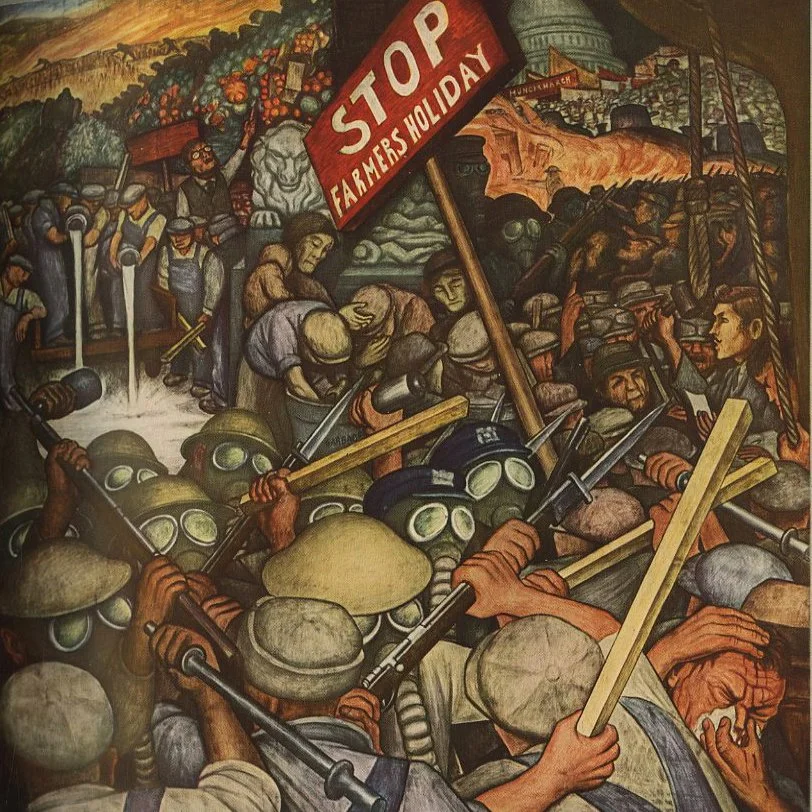 Image 12 of 13
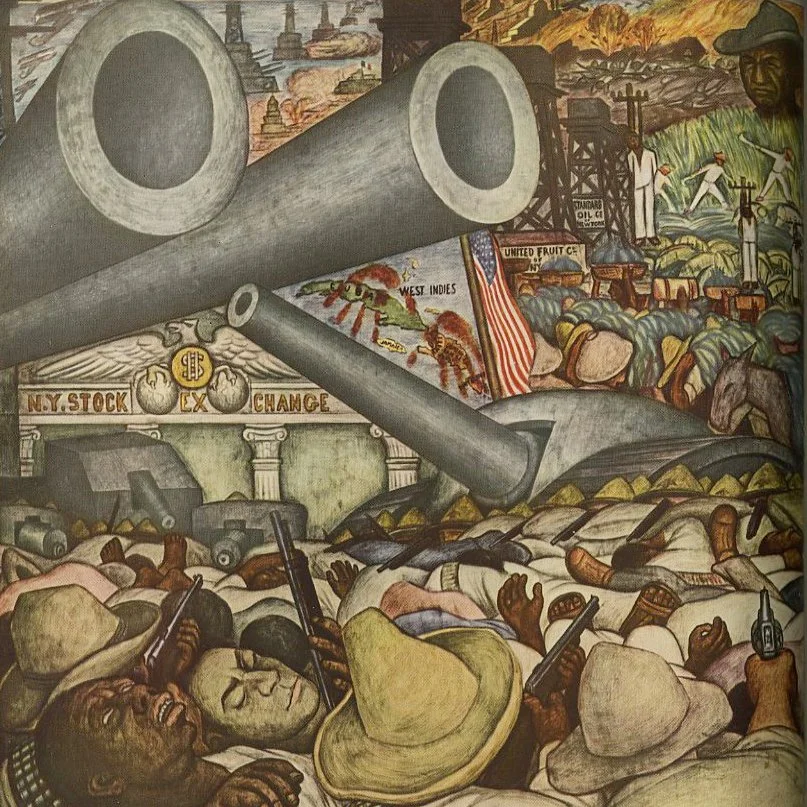 Image 13 of 13
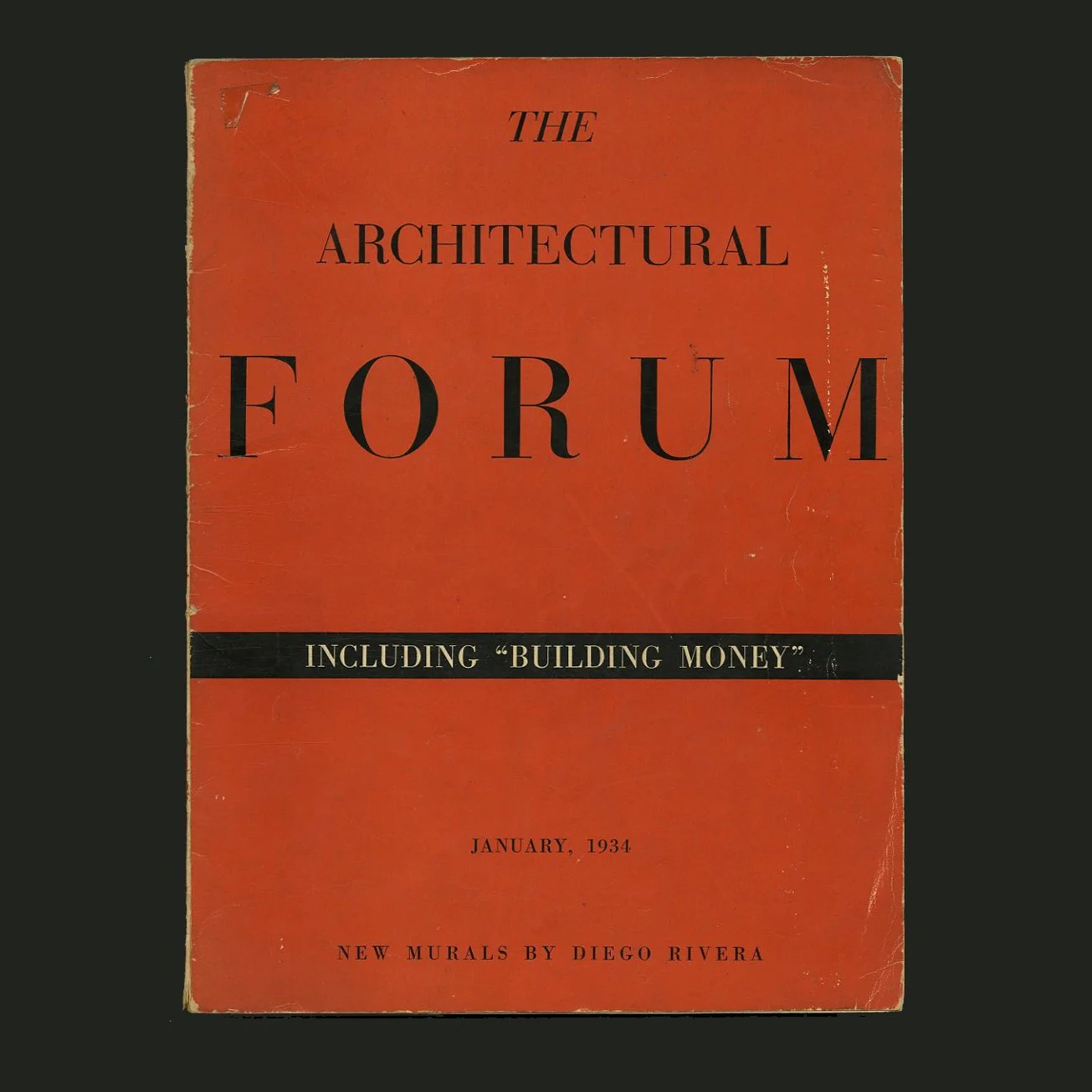
ARCHITECTURAL FORUM, THE. January 1934. Diego Rivera New Workers School Murals; Frederick Kiesler Space House.
THE ARCHITECTURAL FORUM
January 1934
Diego Rivera, Frederick Kiesler [Contributors]
Kenneth Kingsley Stowell [Editor]
Philadelphia: Time, Inc., January 1934 [Volume 60, number 1]. Slim quarto. Thick printed wrappers over sewn binding. 88 [xxxiv] pp. Editorial content and period trade advertising. The spiral binding is in unusually good condition and does not bind any pages when opened. A nice copy thus. Interior unmarked and clean. Wrappers lightly worn, and soiled with a stray tape piece to front panel, but a very good copy or better copy.
8.75 x 11.75 magazine with 126 pages of editorial content showcasing the Architectural and Industrial Design of the American Streamline Moderne Machine Age aesthetic. There are also an excellent assortment of vintage trade advertisements that espouse the depression moderne streamline aesthetic quite nicely. You have been warned.
CONTENTS:
Diego Rivera: Ernest Born introduction with portrait by Esther Born.
Architecture and Mural Painting: Diego Rivera
The Technique of Fresco: A. Sanchez Flores [Technical Assistant to Diego Rivera]
Murals, New Workers School: Diego Rivera Nine pages with two full page color plates and 23 black and white halftones of the 21 panels for a "Portrait of America" series in 1933 for the New Workers' School in New York City. A superb record of one of Rivera's rebound murals after the Radio City debacle. These panels eventually ended up with the ILGWU (International Ladies' Garment Workers' Union) and displayed at their “Unity House” in the Pocono Mountains of Pennsylvania. After a fire in 1969 most of panels were lost. There are supposedly eight still that exist held in private hands and museums.
Space and the Years: Space House and House of Years Six pages and fourteen photographs compare and contract Frederick Kiesler and Modernage's furnishings for Space House with the traditional of good taste represented by W. & J. Sloane. Thurman Rotan, the Pride of Waco, photographed Kiesler’s and the Sloane work. A spirited debate among retailers during the Great Depression regarded the best way to display and sell furniture. In 1934 this modern verses traditional debate was addressed by Frederick Kiesler and his Space House by Modernage, and The House of Years designed by Henry Otis Chapman, Jr. and Harold W. Beder and assembled at the W. & J. Sloane flagship store on Fifth Avenue. If you cannot figure out the winner of this contest then you just haven't been paying attention. The Modernage Furniture Company in New York commissioned Kiesler to build a full scale “model” prototype of a single family house for the window displays of the furniture company. With the aid of new materials and techniques (pre- stressed concrete, plastic and glass) Kiesler aspires to create a unitary, monumental space without foundations in which the surfaces that typically act as boundaries (floors, walls, ceilings) would form a transition and continuum that reflects the demand for maximum flexibility in the layout of the interior space. Kiesler’s “system of tension” in City in Space and the three dimensional possibilities of his earlier space theater project were fundamental principles to the development of the Space House and opening up the potential for interior space within the context of a house. The Space House becomes the first major departure from the formal principals of functionalism based on the rectangle of the international style and Kiesler’s first real articulation of his early developing theories of correalism and theoretical notions for the single-family house. This refines Kiesler’s focus from a concept of Endless Space to the pursuit of the Endless House.
Boring Stuff, including:
Products & Practice
Building Money
Forum Of Events
Books
Letters and most trade material including period advertising
Diego Rivera [Guanajato,1886 – Mexico City, 1957] was established as a painter by age twenty. In 1907, Rivera travelled to Europe and was exposed to the concept of Revolution via his Russian friends. The First World War broke out in Europe, and in Mexico the revolutionary folk hero Emiliano Zapata promoted returning the land to the people. It was in these years Diego Rivera became a revolutionary himself, and felt the call of his country. His friend, David Sternberg, the Soviet People's Commissar of Fine Arts had invited him to Russia, and Diego was tempted to go, but in 1921 he returned to Mexico instead. In addition to his painting activities, which by now was focused increasingly on murals, Diego Rivera participated in the founding of the Revolutionary Union of Technical Workers, Painters and Sculptors in the autumn of 1922, and later that year he joined the Mexican Communist Party. In the autumn of 1927 Diego took a trip to the Soviet Union, as a member of an official delegation of Mexican Communist Party functionaries and various workers representatives, to take part in the tenth anniversary celebrations of the October Revolution.
Lewis Mumford reviewed the New Worker’s School Murals for The New Yorker on January 13, 1934:
“On Fourteenth Street, which was foreordained to sordidness almost from the moment it was built, there stands near Sixth Avenue a dirty building with a black sign at the top that says New Worker’s School. In the front room of the top floor of this ramshackle building there stand in specially constructed steel frames around the wall a series of murals. They are the latest paintings done by Diego Rivera and, next to the buried treasure in the Rockefeller Center, perhaps the most discussed pictures he has painted. Opinions on them are very discordant, for they reflect everything from the state of the owner’s pocketbook to his love for Mexico. But the only opinion on the subject that really annoys me is that these pictures are not murals.
“Let us get that little matter settled right away. A mural is merely a picture that covers a wall. It may be done in tempera, in oil, in charcoal, in glass, or in some still undiscovered medium; it may emphasize the wall or it may efface it; it may be subordinate to the architecture or it may supplant it; it may be decorative and self-effacing, or it may be dramatic and strident. In any case, if it covers most of the wall, it is a mural; and the only reasonable point of inquiry is whether it is a good picture or not. The dogma that a mural should be primarily decorative was probably invented by jealous architects, who likewise invented the other dogma that a mural must be part of the wall; both notions are nonsense. If a painter is good enough to make us forget the architect, that is just so much to his credit. Fortunately, the New Worker’s School doesn’t boast any “architecture,” good or bad; the panels stand in an oblong room, and instead of being treated as decorations tending to create a fictitious ornateness, they should be appraised for what they actually are—illustrations, a sort of universal history of the working classes, with the emphasis upon America, by one of the most intelligent minds among our contemporaries.
“Rivera’s murals here are not to be taken in with a sweep of the eye. They are crowded from top to bottom like a page of Karl Marx’s “Das Kapital,” with a main thesis, like the bold text, in the foreground, with quotations and bibliographical references, from Jefferson, from Calhoun, from various other worthies; and then there are further footnotes and illustrations, such as Marx scatters through his work, on the upper part of the panels. Portrait and story, biography and history intermingle. The symbolisms used are direct and graphic: Hitler bawls with open mouth a small hospital scene of sterilization, and wears a modest pansy in his necktie; and though one of the panels is a sort of apotheosis of Lenin, he is shown surrounded by the real men who assisted him, not by an ideal proletariat. One naturally misses the clarity and the serene large masses of Rivera’s earlier murals, and one must not look for these qualities; this is something different. These murals constitute a book, crowded with Rivera’s comments upon Capitalism and Communism, upon Fascism and Revolution; it is his “Comédie Humaine,” or, rather, his “Inferno” and “Purgatorio” of the working classes; it is meant to challenge, disturb, exacerbate, exhort. But this is propaganda? Of course it is propaganda, like Christian art from the earliest origins onward. As painting, its weakness does not spring from the propaganda but from the lack of precision in small details of the background. But the portraiture is often excellent; and if one reads the pictures, instead of merely looking at them, one will find that Rivera accomplished what he set out to do.
Throughout his career, Frederick Kiesler [Austria-Hungary, 1890 – 1965] worked across multiple mediums. He believed that “sculpture, painting, architecture should not be used as wedges to split our experience of art and life; they are here to link, to correlate, to bind dream and reality.” After studying painting and printmaking in Vienna in the early 1900s, he became known in Europe for his inventive stage designs, featuring mirrors and projections. In the course of working on these projects, he met and at times collaborated with artists such as El Lissitzky and László Moholy-Nagy. In 1923, Dutch artist Theo van Doesburg invited him to join de Stijl, making him the group’s youngest member.
In 1926, after traveling to New York to co-organize the International Theatre Exposition at Steinway Hall, Kiesler and his wife immigrated to the United States and settled in the city. There, Kiesler helped spread the ideas of the European avant-garde, such as non-objective painting, abstraction, and the merging of art and life. He found work as a professor at Columbia University’s School of Architecture and as the director of scenic design at the Juilliard School of Music. From 1937 to 1942, Kiesler was the director of the Laboratory for Design Correlation within the Department of Architecture at Columbia University, where the study program was more pragmatic and commercially oriented than his deep, theoretical concepts and ideas, such as those about "correalism" or "continuity," which concern the relationship among space, people, objects and concepts.
“During the 1930s, Kiesler devoted much of his time to elaborating his design theories, publishing articles (including a series in Architectural Record on "Design Correlation"), and lecturing at universities and design conferences around the country, gaining notoriety for, among other things, his exhortations on the mean-spirited character of the American bathroom and the pressing need for a nonskid bathtub. He also called for the founding of an industrial design institute (for which he prepared architectural plans in 1934) and eventually persuaded Columbia University to allow him to set up an experimental Laboratory for Design Correlation within the School of Architecture. This laboratory, which functioned from 1937 to 1942, was the testing ground for many of Kiesler's biotechnical ideas. During this period, he actively experimented with new materials and techniques, such as lucite and cast aluminum, and executed some of the extraordinarily sensual, organic furniture designs that presaged the form-fitting, ergonomic concepts of the 1940s and 1950s.
In 1942, he was chosen to design collector and art dealer Peggy Guggenheim’s Art of This Century Gallery in New York, for which he planned every aspect, from an innovative method of installing paintings to its lighting, sculpture stands, and seating. In 1947, he designed the installation Salle Superstition for the Exposition Internationale du Surréalisme, organized by Marcel Duchamp and André Breton at the Galerie Maeght in Paris. In this exhibition, Kiesler also displayed his first work of sculpture, Totem for All Religions, a wood-and-rope construction that stands more than nine feet tall and simultaneously evokes a totem pole, a crucifix, and various astronomical symbols.
Kiesler’s longest-running project was Endless House, a single-family dwelling whose biomorphic form and lack of corners strongly contrasted with the hard geometric edges that defined most modern architecture of the time. He sought to design a structure responsive to the occupants’ functional and spiritual requirements. He developed his ideas for the house over several decades, creating numerous sketches and models. Although plans were made to build a to-scale model in MoMA’s Sculpture Garden in 1958, they did not materialize, and the project remains unrealized. Nonetheless, Kiesler’s Endless House concept was highly influential and stands as a strong expression of his bold statement: “Form does not follow function. Function follows vision. Vision follows reality.”
“Kiesler's Greenwich Village apartment at 56 Seventh Avenue was a haven for visiting and emigre Europeans. They were not only welcomed there by Kiesler but by symbols of America — the Statue of Liberty and the Empire State Building were clearly visible from his penthouse apartment (which was otherwise described by the doorman as a cross between a studio, apartment, and junk shop). Among his many guests were Marcel Duchamp, Fernand Leger, Mies van der Rohe, Hans Richter, Jean Arp, and Piet Mondrian. Kiesler generously introduced the newcomers to curators, critics, and dealers — Philip Johnson, Alfred H. Barr, Jr., James Johnson Sweeney, Sidney and Harriet Janis — as well as to other artists and prominent friends such as Arnold Schonberg, Frank Lloyd Wright, Martha Graham, E.E. Cummings, Virgil Thomson, Edgard Varese, and Djane Barnes. Committed to fostering an active exchange of ideas among artists of all disciplines and nationalities, Kiesler also relished the potential drama of these encounters. The spirit of the old Vienna cafe days remained with him, and most of his evenings were spent talking with his friends at Romany Marie's or other Village haunts into the early hours of the morning. He never took phone calls before noon. “ [Lisa Phillips]
THE ARCHITECTURAL FORUM
January 1934
Diego Rivera, Frederick Kiesler [Contributors]
Kenneth Kingsley Stowell [Editor]
Philadelphia: Time, Inc., January 1934 [Volume 60, number 1]. Slim quarto. Thick printed wrappers over sewn binding. 88 [xxxiv] pp. Editorial content and period trade advertising. The spiral binding is in unusually good condition and does not bind any pages when opened. A nice copy thus. Interior unmarked and clean. Wrappers lightly worn, and soiled with a stray tape piece to front panel, but a very good copy or better copy.
8.75 x 11.75 magazine with 126 pages of editorial content showcasing the Architectural and Industrial Design of the American Streamline Moderne Machine Age aesthetic. There are also an excellent assortment of vintage trade advertisements that espouse the depression moderne streamline aesthetic quite nicely. You have been warned.
CONTENTS:
Diego Rivera: Ernest Born introduction with portrait by Esther Born.
Architecture and Mural Painting: Diego Rivera
The Technique of Fresco: A. Sanchez Flores [Technical Assistant to Diego Rivera]
Murals, New Workers School: Diego Rivera Nine pages with two full page color plates and 23 black and white halftones of the 21 panels for a "Portrait of America" series in 1933 for the New Workers' School in New York City. A superb record of one of Rivera's rebound murals after the Radio City debacle. These panels eventually ended up with the ILGWU (International Ladies' Garment Workers' Union) and displayed at their “Unity House” in the Pocono Mountains of Pennsylvania. After a fire in 1969 most of panels were lost. There are supposedly eight still that exist held in private hands and museums.
Space and the Years: Space House and House of Years Six pages and fourteen photographs compare and contract Frederick Kiesler and Modernage's furnishings for Space House with the traditional of good taste represented by W. & J. Sloane. Thurman Rotan, the Pride of Waco, photographed Kiesler’s and the Sloane work. A spirited debate among retailers during the Great Depression regarded the best way to display and sell furniture. In 1934 this modern verses traditional debate was addressed by Frederick Kiesler and his Space House by Modernage, and The House of Years designed by Henry Otis Chapman, Jr. and Harold W. Beder and assembled at the W. & J. Sloane flagship store on Fifth Avenue. If you cannot figure out the winner of this contest then you just haven't been paying attention. The Modernage Furniture Company in New York commissioned Kiesler to build a full scale “model” prototype of a single family house for the window displays of the furniture company. With the aid of new materials and techniques (pre- stressed concrete, plastic and glass) Kiesler aspires to create a unitary, monumental space without foundations in which the surfaces that typically act as boundaries (floors, walls, ceilings) would form a transition and continuum that reflects the demand for maximum flexibility in the layout of the interior space. Kiesler’s “system of tension” in City in Space and the three dimensional possibilities of his earlier space theater project were fundamental principles to the development of the Space House and opening up the potential for interior space within the context of a house. The Space House becomes the first major departure from the formal principals of functionalism based on the rectangle of the international style and Kiesler’s first real articulation of his early developing theories of correalism and theoretical notions for the single-family house. This refines Kiesler’s focus from a concept of Endless Space to the pursuit of the Endless House.
Boring Stuff, including:
Products & Practice
Building Money
Forum Of Events
Books
Letters and most trade material including period advertising
Diego Rivera [Guanajato,1886 – Mexico City, 1957] was established as a painter by age twenty. In 1907, Rivera travelled to Europe and was exposed to the concept of Revolution via his Russian friends. The First World War broke out in Europe, and in Mexico the revolutionary folk hero Emiliano Zapata promoted returning the land to the people. It was in these years Diego Rivera became a revolutionary himself, and felt the call of his country. His friend, David Sternberg, the Soviet People's Commissar of Fine Arts had invited him to Russia, and Diego was tempted to go, but in 1921 he returned to Mexico instead. In addition to his painting activities, which by now was focused increasingly on murals, Diego Rivera participated in the founding of the Revolutionary Union of Technical Workers, Painters and Sculptors in the autumn of 1922, and later that year he joined the Mexican Communist Party. In the autumn of 1927 Diego took a trip to the Soviet Union, as a member of an official delegation of Mexican Communist Party functionaries and various workers representatives, to take part in the tenth anniversary celebrations of the October Revolution.
Lewis Mumford reviewed the New Worker’s School Murals for The New Yorker on January 13, 1934:
“On Fourteenth Street, which was foreordained to sordidness almost from the moment it was built, there stands near Sixth Avenue a dirty building with a black sign at the top that says New Worker’s School. In the front room of the top floor of this ramshackle building there stand in specially constructed steel frames around the wall a series of murals. They are the latest paintings done by Diego Rivera and, next to the buried treasure in the Rockefeller Center, perhaps the most discussed pictures he has painted. Opinions on them are very discordant, for they reflect everything from the state of the owner’s pocketbook to his love for Mexico. But the only opinion on the subject that really annoys me is that these pictures are not murals.
“Let us get that little matter settled right away. A mural is merely a picture that covers a wall. It may be done in tempera, in oil, in charcoal, in glass, or in some still undiscovered medium; it may emphasize the wall or it may efface it; it may be subordinate to the architecture or it may supplant it; it may be decorative and self-effacing, or it may be dramatic and strident. In any case, if it covers most of the wall, it is a mural; and the only reasonable point of inquiry is whether it is a good picture or not. The dogma that a mural should be primarily decorative was probably invented by jealous architects, who likewise invented the other dogma that a mural must be part of the wall; both notions are nonsense. If a painter is good enough to make us forget the architect, that is just so much to his credit. Fortunately, the New Worker’s School doesn’t boast any “architecture,” good or bad; the panels stand in an oblong room, and instead of being treated as decorations tending to create a fictitious ornateness, they should be appraised for what they actually are—illustrations, a sort of universal history of the working classes, with the emphasis upon America, by one of the most intelligent minds among our contemporaries.
“Rivera’s murals here are not to be taken in with a sweep of the eye. They are crowded from top to bottom like a page of Karl Marx’s “Das Kapital,” with a main thesis, like the bold text, in the foreground, with quotations and bibliographical references, from Jefferson, from Calhoun, from various other worthies; and then there are further footnotes and illustrations, such as Marx scatters through his work, on the upper part of the panels. Portrait and story, biography and history intermingle. The symbolisms used are direct and graphic: Hitler bawls with open mouth a small hospital scene of sterilization, and wears a modest pansy in his necktie; and though one of the panels is a sort of apotheosis of Lenin, he is shown surrounded by the real men who assisted him, not by an ideal proletariat. One naturally misses the clarity and the serene large masses of Rivera’s earlier murals, and one must not look for these qualities; this is something different. These murals constitute a book, crowded with Rivera’s comments upon Capitalism and Communism, upon Fascism and Revolution; it is his “Comédie Humaine,” or, rather, his “Inferno” and “Purgatorio” of the working classes; it is meant to challenge, disturb, exacerbate, exhort. But this is propaganda? Of course it is propaganda, like Christian art from the earliest origins onward. As painting, its weakness does not spring from the propaganda but from the lack of precision in small details of the background. But the portraiture is often excellent; and if one reads the pictures, instead of merely looking at them, one will find that Rivera accomplished what he set out to do.
Throughout his career, Frederick Kiesler [Austria-Hungary, 1890 – 1965] worked across multiple mediums. He believed that “sculpture, painting, architecture should not be used as wedges to split our experience of art and life; they are here to link, to correlate, to bind dream and reality.” After studying painting and printmaking in Vienna in the early 1900s, he became known in Europe for his inventive stage designs, featuring mirrors and projections. In the course of working on these projects, he met and at times collaborated with artists such as El Lissitzky and László Moholy-Nagy. In 1923, Dutch artist Theo van Doesburg invited him to join de Stijl, making him the group’s youngest member.
In 1926, after traveling to New York to co-organize the International Theatre Exposition at Steinway Hall, Kiesler and his wife immigrated to the United States and settled in the city. There, Kiesler helped spread the ideas of the European avant-garde, such as non-objective painting, abstraction, and the merging of art and life. He found work as a professor at Columbia University’s School of Architecture and as the director of scenic design at the Juilliard School of Music. From 1937 to 1942, Kiesler was the director of the Laboratory for Design Correlation within the Department of Architecture at Columbia University, where the study program was more pragmatic and commercially oriented than his deep, theoretical concepts and ideas, such as those about "correalism" or "continuity," which concern the relationship among space, people, objects and concepts.
“During the 1930s, Kiesler devoted much of his time to elaborating his design theories, publishing articles (including a series in Architectural Record on "Design Correlation"), and lecturing at universities and design conferences around the country, gaining notoriety for, among other things, his exhortations on the mean-spirited character of the American bathroom and the pressing need for a nonskid bathtub. He also called for the founding of an industrial design institute (for which he prepared architectural plans in 1934) and eventually persuaded Columbia University to allow him to set up an experimental Laboratory for Design Correlation within the School of Architecture. This laboratory, which functioned from 1937 to 1942, was the testing ground for many of Kiesler's biotechnical ideas. During this period, he actively experimented with new materials and techniques, such as lucite and cast aluminum, and executed some of the extraordinarily sensual, organic furniture designs that presaged the form-fitting, ergonomic concepts of the 1940s and 1950s.
In 1942, he was chosen to design collector and art dealer Peggy Guggenheim’s Art of This Century Gallery in New York, for which he planned every aspect, from an innovative method of installing paintings to its lighting, sculpture stands, and seating. In 1947, he designed the installation Salle Superstition for the Exposition Internationale du Surréalisme, organized by Marcel Duchamp and André Breton at the Galerie Maeght in Paris. In this exhibition, Kiesler also displayed his first work of sculpture, Totem for All Religions, a wood-and-rope construction that stands more than nine feet tall and simultaneously evokes a totem pole, a crucifix, and various astronomical symbols.
Kiesler’s longest-running project was Endless House, a single-family dwelling whose biomorphic form and lack of corners strongly contrasted with the hard geometric edges that defined most modern architecture of the time. He sought to design a structure responsive to the occupants’ functional and spiritual requirements. He developed his ideas for the house over several decades, creating numerous sketches and models. Although plans were made to build a to-scale model in MoMA’s Sculpture Garden in 1958, they did not materialize, and the project remains unrealized. Nonetheless, Kiesler’s Endless House concept was highly influential and stands as a strong expression of his bold statement: “Form does not follow function. Function follows vision. Vision follows reality.”
“Kiesler's Greenwich Village apartment at 56 Seventh Avenue was a haven for visiting and emigre Europeans. They were not only welcomed there by Kiesler but by symbols of America — the Statue of Liberty and the Empire State Building were clearly visible from his penthouse apartment (which was otherwise described by the doorman as a cross between a studio, apartment, and junk shop). Among his many guests were Marcel Duchamp, Fernand Leger, Mies van der Rohe, Hans Richter, Jean Arp, and Piet Mondrian. Kiesler generously introduced the newcomers to curators, critics, and dealers — Philip Johnson, Alfred H. Barr, Jr., James Johnson Sweeney, Sidney and Harriet Janis — as well as to other artists and prominent friends such as Arnold Schonberg, Frank Lloyd Wright, Martha Graham, E.E. Cummings, Virgil Thomson, Edgard Varese, and Djane Barnes. Committed to fostering an active exchange of ideas among artists of all disciplines and nationalities, Kiesler also relished the potential drama of these encounters. The spirit of the old Vienna cafe days remained with him, and most of his evenings were spent talking with his friends at Romany Marie's or other Village haunts into the early hours of the morning. He never took phone calls before noon. “ [Lisa Phillips]